ALTIOR AI ADVANTAGERead the blog
Altior Daily AI Briefing

Why the Cheapest Token Is Not Always the Cheapest Task

2026-09-23 — New releases from OpenAI, Anthropic and xAI put pricing and endurance at the centre of model selection: the relevant measure is the cost, time and review needed to finish the work.

Why the Cheapest Token Is Not Always the Cheapest Task
The day in view

The day in view

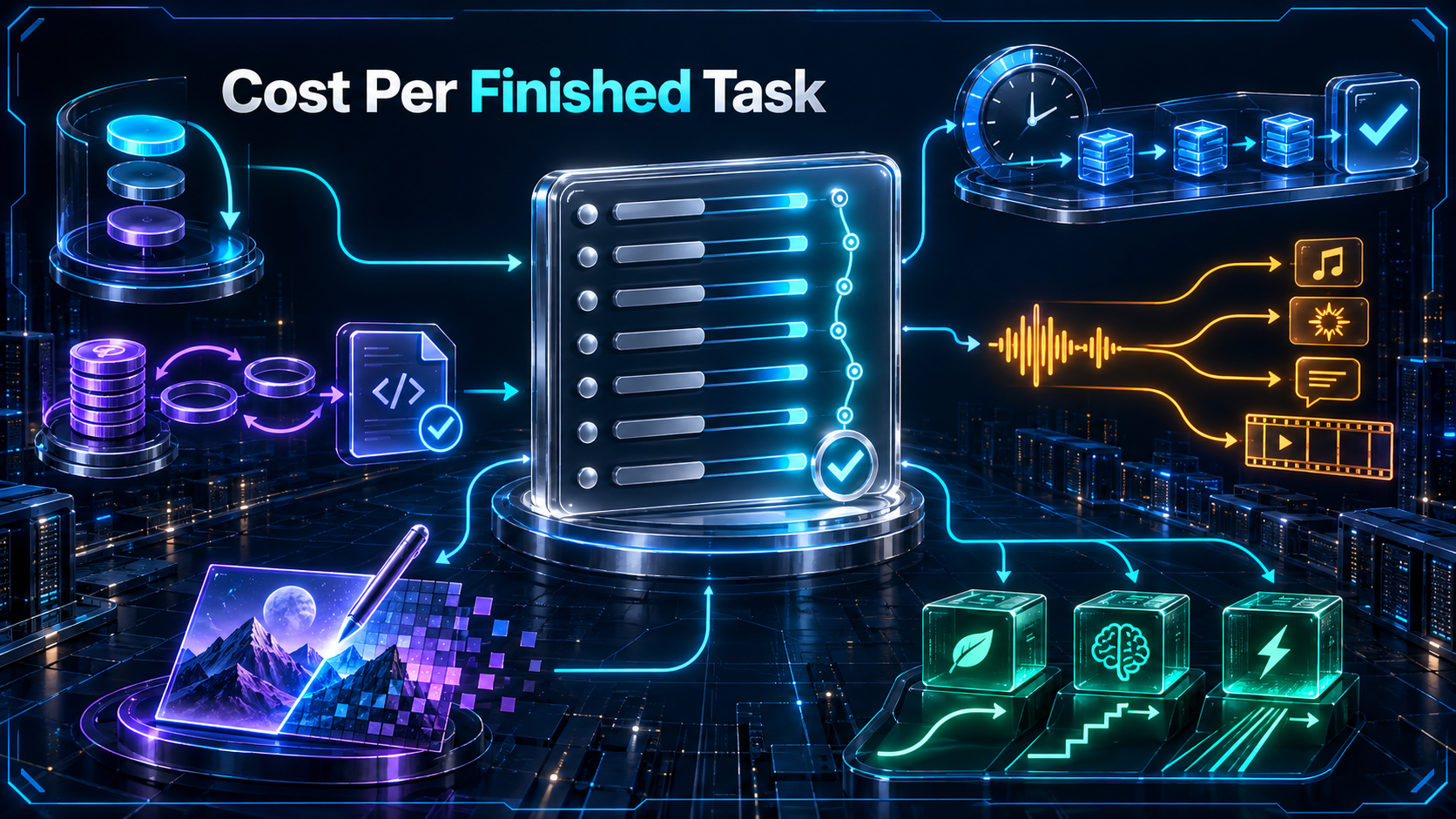
This day’s releases put more than token prices on the table. OpenAI and Anthropic make lower-cost claims around new model options, while xAI makes a case for work that holds together over longer runs. The useful comparison is not a headline rate alone: it is the cost, time and review required to finish a task to an acceptable standard.

Altior — our view today
OpenAI / ChatGPT / Codex

OpenAI / ChatGPT / Codex

GPT-6 Sol and Luna: The Cost Claim Needs a Closer Look

OpenAI positions Astra for its strongest results, Sol for complex coding and professional work, and Luna for fast everyday work at scale. It says Sol and Luna have 50% lower API prices than GPT-5.6 promotional pricing, attributing the change to more efficient caching and inference. The public material gives a role map and a promotional comparison, but not the unit basis, access terms or workload evidence needed to turn that claim into a buying result. For an operator, the relevant comparison is a representative task run under consistent success criteria: output quality, elapsed time, retries and the bill shown for the completed work. The launch claim is useful as a test hypothesis, not as a completed saving.

Our takeOur take: compare Sol and Luna on the work you actually need done before treating a promotional rate as a cost-per-task advantage.

Source
Anthropic / Claude

Anthropic / Claude

Opus 5.5: Cheaper Tokens, But Cheaper Tasks?

Anthropic lists Opus 5.5 at $4 per million input tokens, $20 per million output tokens and $0.20 per million cache-read tokens. It says input and output pricing is 20% lower than Opus 5, while cache reads are 60% lower. The company also frames Opus 5.5 as a daily driver for coding and agentic work. That changes the meter, but a coding task is rarely one clean transaction. Turns, tool calls, retries, context reuse, output volume and effort all affect the final receipt. A lower token rate can reduce the cost of the same task; it does not guarantee that every task costs less to finish. The operational test is to compare an equivalent, checkable task before and after a model change, retaining both result quality and the route the task took.

Our takeOur take: measure completed work alongside turns, retries, cache use and review effort; token price alone is not the unit of value.

Source
xAI / Grok

xAI / Grok

Grok 4.7 Is Built for the Jobs That Last Hours

xAI says Grok 4.7 is designed for difficult coding and knowledge-work tasks that run for many hours. Its launch claims centre on a larger base model, a longer reinforcement-learning run, stronger long-context management and self-verification. xAI also lists starting standard pricing of $2 per million input tokens and $6 per million output tokens; its fast option is described as twice the output speed at twice the price. The proposition is not just a cheaper meter. It is whether a model can keep the objective intact as work branches through research, drafting, coding, checking and revision. That is a meaningful evaluation target, but the evidence here is supplier-published launch material, not independent proof of reliability or long-task advantage. Human review remains part of the test.

Our takeOur take: use a demanding, staged task to test continuity, late-stage errors and review burden—not a short prompt or a launch demonstration.

Source
Alibaba Qwen

Alibaba Qwen

Qwen-Image-2.1: One Model for Making and Editing Images

Qwen says Qwen-Image-2.1 uses one open-weight checkpoint for both image generation and editing. Its release material highlights text rendering, portrait quality and a character-reference-to-storyboard example, alongside reported browser, local and integration routes. The practical attraction is clear: a shared model could reduce the hand-off between making an image and revising it. But a polished example is not a reliability result. Image work becomes expensive when exact words lose legibility, a character drifts across a sequence, or a targeted edit changes more than it should. Qwen’s examples make the workflow worth testing, not assumed. A useful evaluation would connect a text-bearing graphic, a short character-led storyboard and one constrained revision, then inspect what remains accurate across the sequence.

Our takeOur take: test legibility, character continuity and edit precision on your own connected brief before treating one checkpoint as a simpler production workflow.

Source
OpenRouter

OpenRouter

MiMo-V2.6: One Model Family, Three Builder Bets

OpenRouter says Xiaomi’s MiMo-V2.6 family offers three distinct operating choices: Pro for flagship depth and long-horizon agentic work, Flash as a 309B mixture-of-experts model with 15B active parameters, and Pro-UltraSpeed as the same Pro checkpoint with roughly ten times the output speed. It says all three accept text, image, video and audio, with a one-million-token context window. The useful part of this launch is the routing frame. It separates depth, active-model efficiency and output speed rather than presenting one universal winner. The specifications and performance framing are OpenRouter’s published claims, not independent evidence of production reliability, cost or quality on a particular workload. A team should start with the actual constraint—long-running depth, serving efficiency or output speed—then test a representative input with a clear success condition.

Our takeOur take: choose the constraint first, then validate the variant on representative work; family labels are not a substitute for a measured route to a finished result.

Source
ElevenLabs

ElevenLabs

Studio 4.0 in ElevenCreative

ElevenLabs presents Studio 4.0 in ElevenCreative as an AI-native editor for video creators, podcasters and audiobook authors. Its public Studio page describes a single editor that combines AI voiceovers, music, sound effects, captions, transcription, voice isolation and video support. The product framing is broad: create, edit and publish with AI-assisted audio and video tools in one workflow. For a production team, the question is less whether each feature exists than whether the hand-offs between script, voice, music, captions and final edit reduce work without creating new review points. The page is a supplier product description, so it does not establish fit for a specific content workflow, pricing outcome or quality standard. A short end-to-end trial is the sensible next check.

Our takeOur take: assess Studio 4.0 as a workflow test—one real asset from script to checked export—rather than as a list of individual AI features.

Source
ALTIOR AI ADVANTAGE
Keep reading

Build with evidence.

Build AI systems with controls that can survive review.

The Altior blogThe prompt library