Grok 4.6: Can It Keep Going?
xAI’s Grok 4.6 pitch is about staying with difficult work long enough to turn a broad idea into a usable first version.

A polished first response can make almost any project feel briefly within reach. The work gets harder once the brief grows untidy: unfamiliar information arrives, choices collide, code needs checking and the first version exposes what the original idea missed.
xAI says Grok 4.6 is built for that longer stretch—across research, analysis, codebases and polished work. The claim is ambitious; the evidence in this pack remains xAI-published.
Starting Is the Easy Part
The useful question is whether an assistant can preserve a project’s intent once the work stops being tidy.
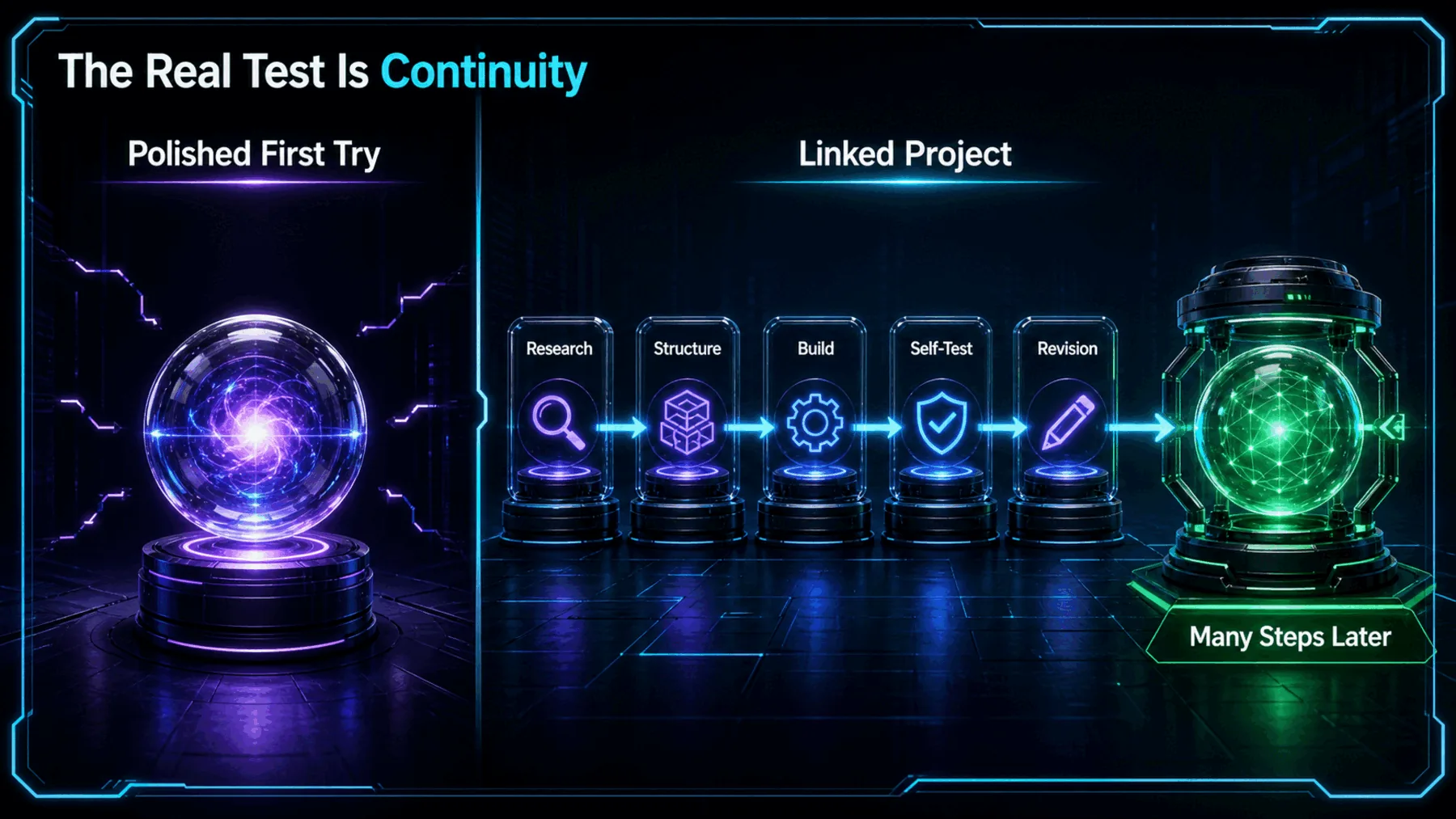
A broad product idea does not arrive as a clean sequence of tasks. We have to gather context, decide what matters, make the main interactions work and then confront the places where the first plan breaks down.
xAI’s case for Grok 4.6 is that it can hold onto that continuity. If that holds up in real work, it matters more than a clever starting point. This source pack does not independently establish that it does.
What xAI Is Claiming
xAI frames Grok 4.6 as an upgrade in endurance, iteration and work that crosses several kinds of task.
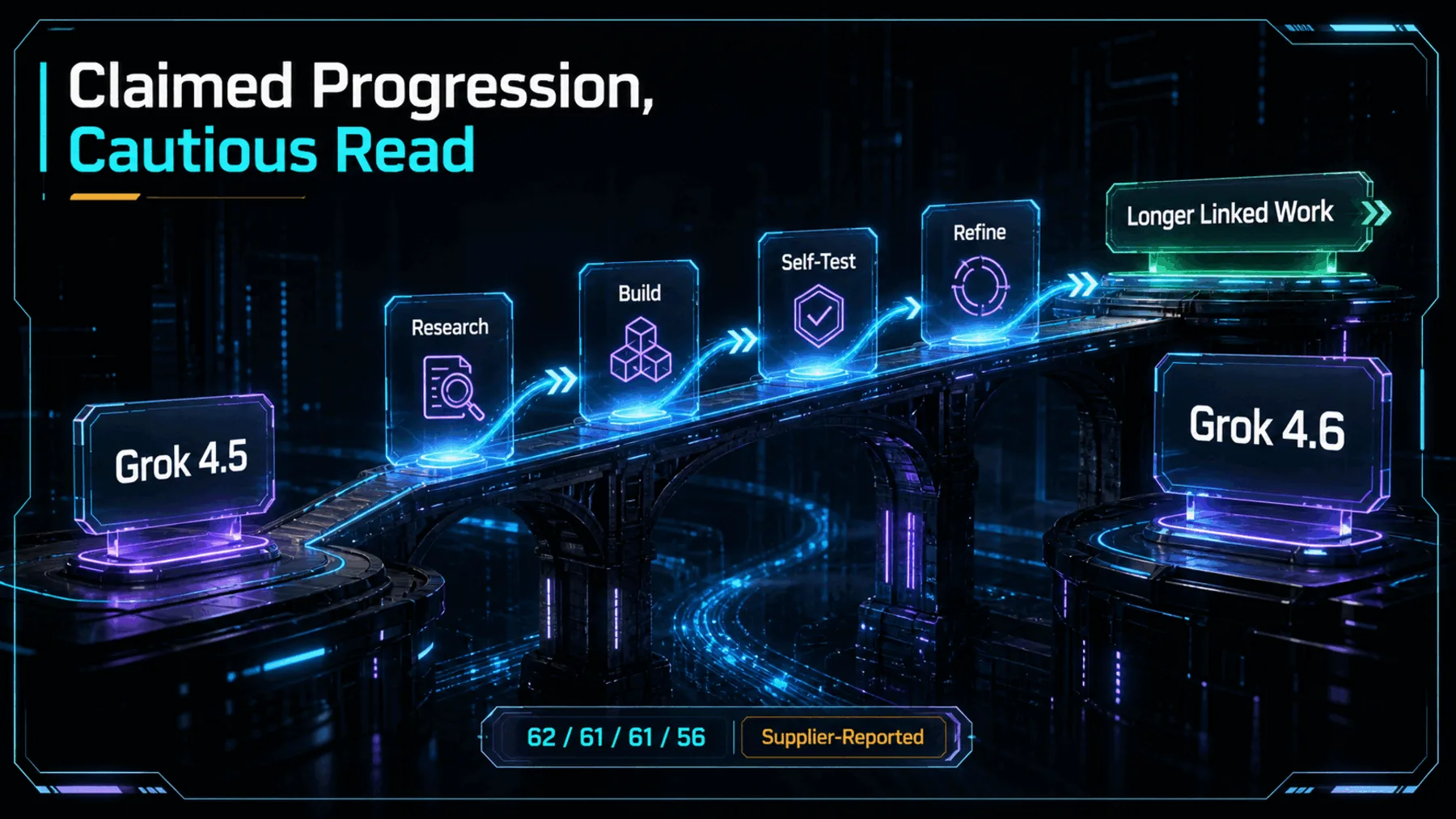
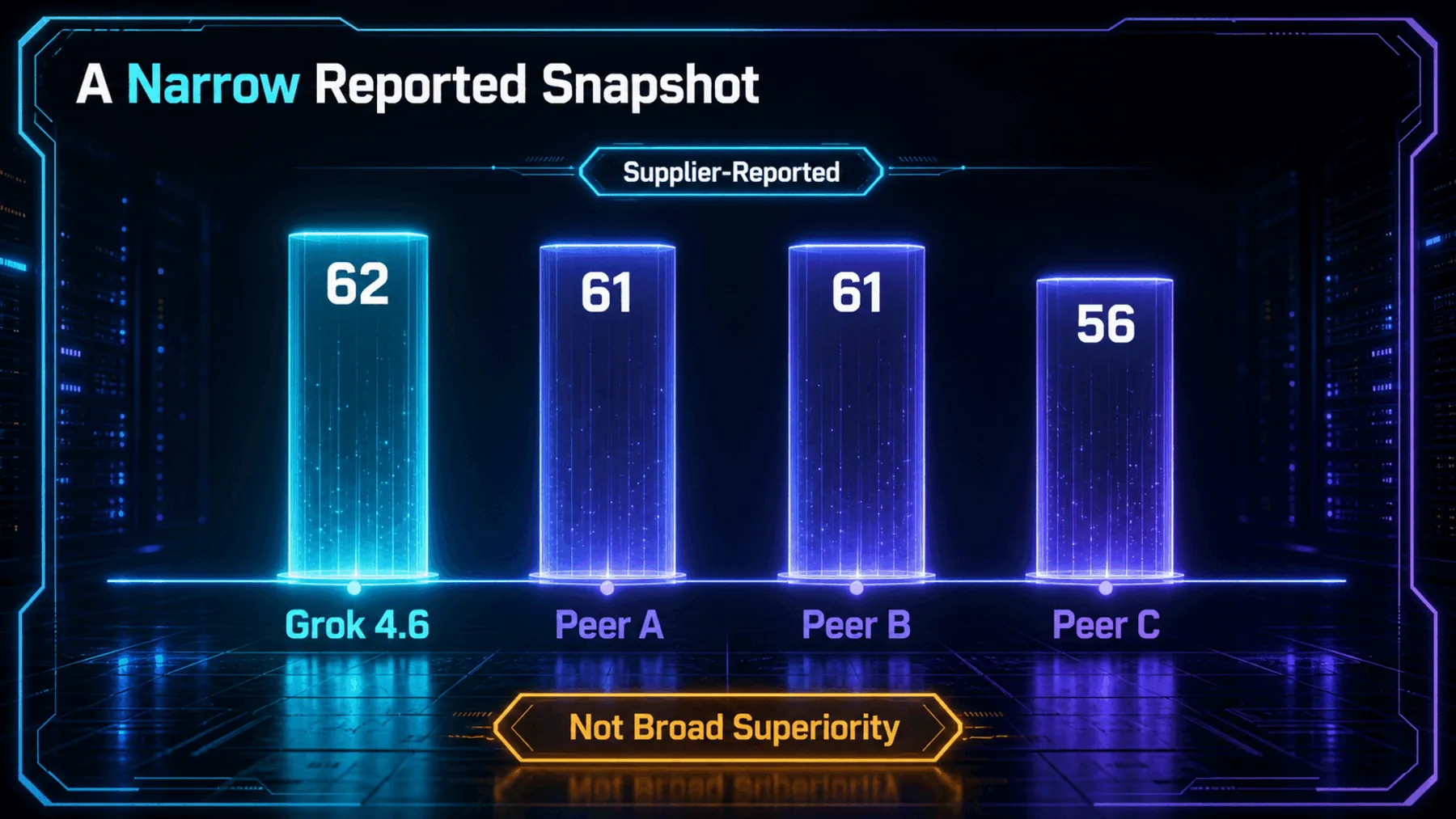
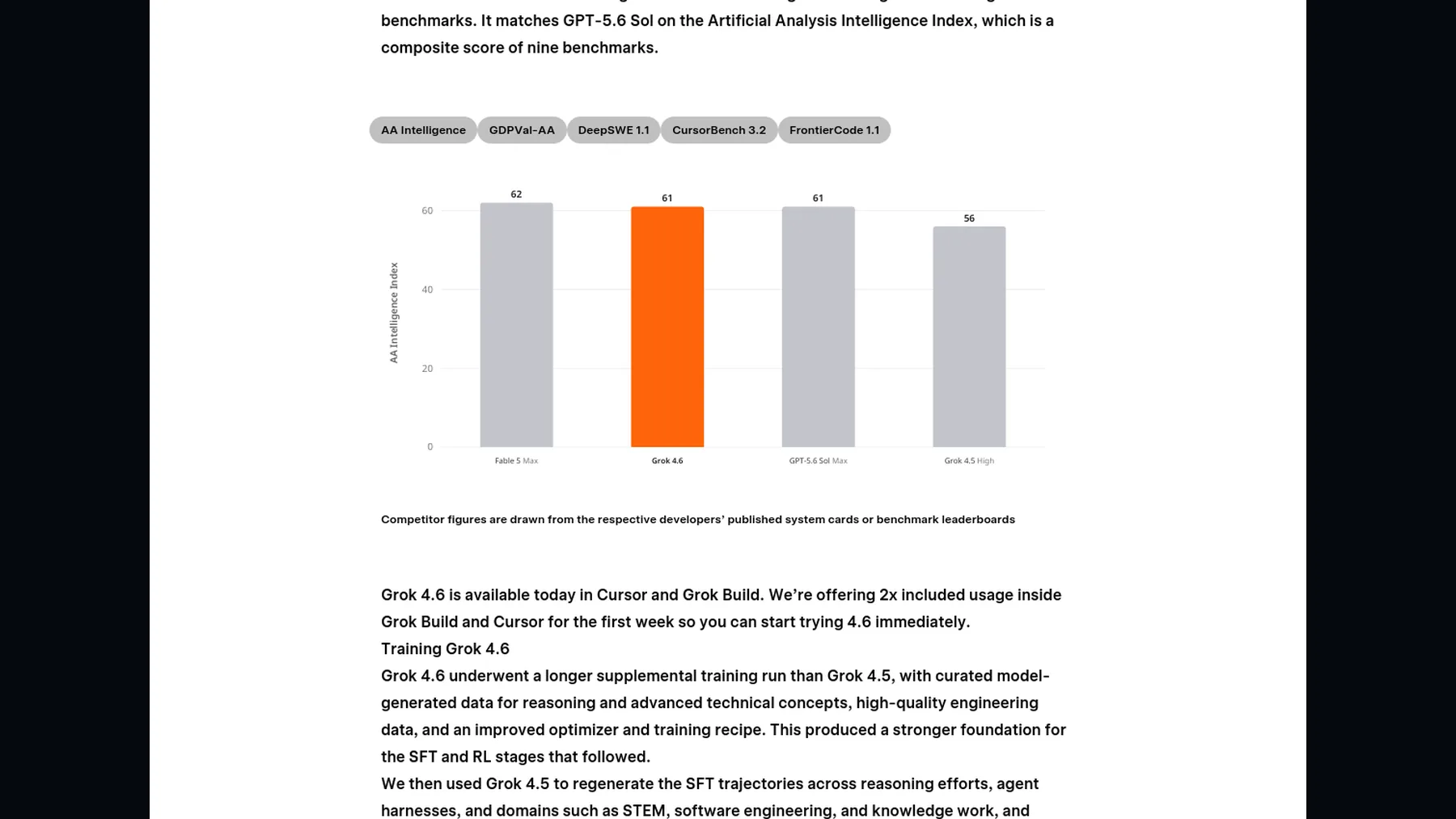
The headline number gives the release some context, but it is not the story’s finish line. xAI reports a 61 on the AA Intelligence Index, matching GPT-5.6 Sol Max, trailing Fable 5 Max at 62 and improving on Grok 4.5 High at 56.
The chart’s own qualification matters: the best score in each evaluation is shown in bold, and third-party figures are the best self-reported or publicly available results. It is useful evidence of what xAI published, not a broad verdict on every task.
What the Chart Can Prove
The approved figure records xAI’s comparison; it does not settle how a messy project will unfold in practice.
On longer trajectories, we also started to see more self-testing and verification, with the model checking its own work before moving on.
xAI, “Introducing Grok 4.6”
This is the most interesting line in the release. A system that can notice a weak result, test it and revise before pressing on would change the shape of a long project.
But the quotation is still xAI’s account of its own testing. We should treat it as a focused capability claim until independent completion evidence shows how consistently that loop survives real constraints.
Proof, With Limits
The source supports a clear account of xAI’s ambition. It does not independently verify dependable completion or safety superiority.
The distinction is simple but important. xAI has supplied examples, benchmark results and a description of the behaviour it observed. None of that becomes independent proof merely because the release is polished.
The same limit applies to safety. xAI reports improved and calibrated safeguards, alongside extensive testing, but this source pack contains no independent evaluation that would let us rank those safeguards against anyone else’s.
Hold the Thread Through the Work
xAI’s model of progress is a linked loop: learn what is needed, build, inspect, then improve without losing the original aim.
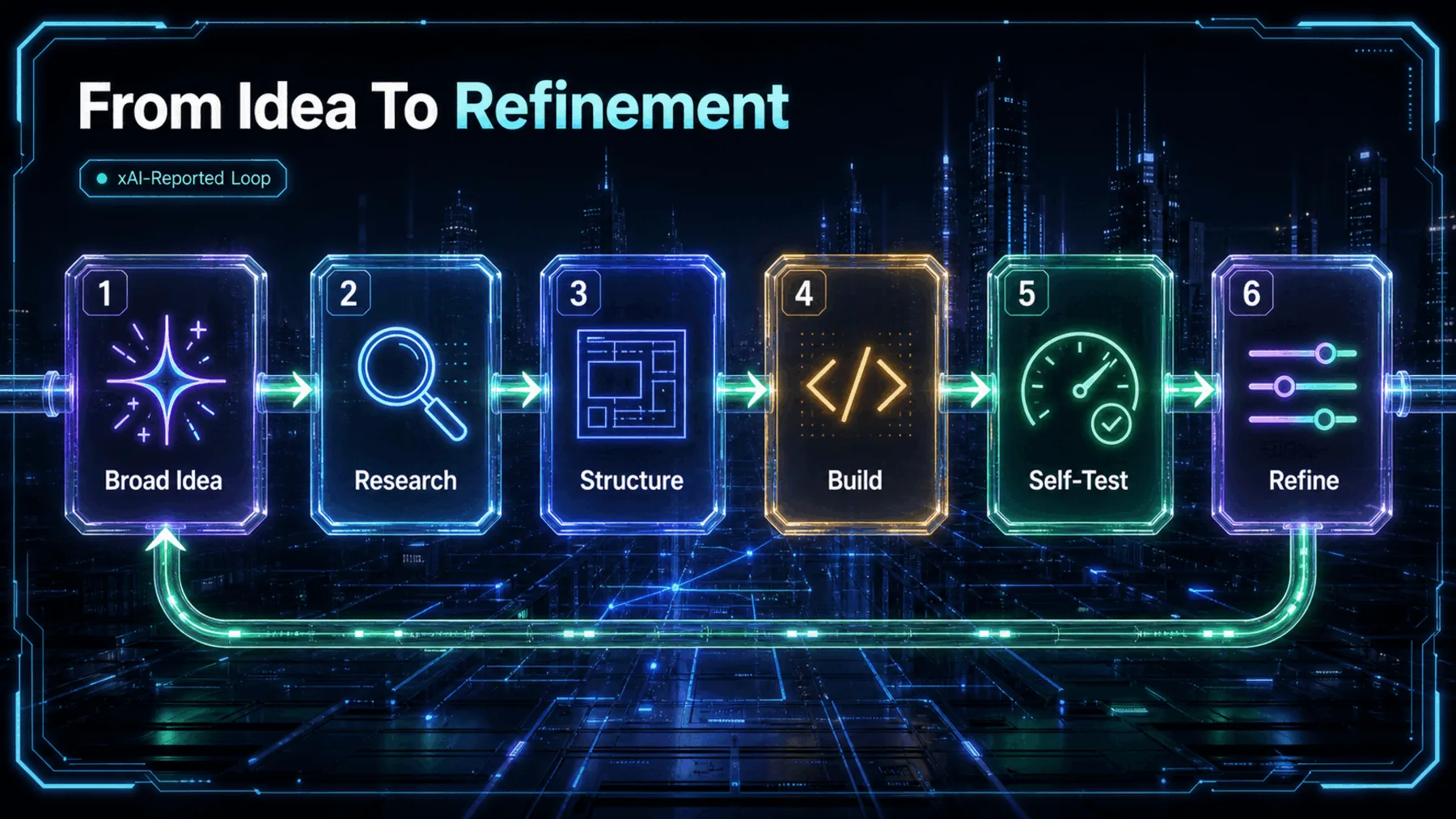
In plain language, the promise is not mysterious. Start with an idea that needs unfamiliar information. Shape it into a plan. Build the important interactions. Check what happened. Then feed the result back into the next pass.
Each hand-off is where projects usually lose their thread. xAI says Grok 4.6 is intended to carry context across those hand-offs and make stronger first passes while the work remains in motion.
Gather
Find the information the project needs before committing to a direction.
Build
Turn the plan into the main structure and interactions.
Revise
Inspect the result, test the weak points and improve the next pass.
Try It on the Messy Bit
The first useful test is not a polished prompt. It is a real project with dependencies, ambiguity and a reason to check the work twice.

We would learn more from one stubborn project than from a sequence of clean demonstrations. Choose work with a real constraint, a decision that depends on research and a result that can be checked after the first build.
Keep the test narrow enough to inspect. The question is whether the intent survives each turn of the loop—not whether the tool can produce an impressive fragment before the difficult parts arrive.
Context
Does the original aim survive as new information changes the plan?
Correction
Does the work surface mistakes that can be checked and repaired?
Terms
Are current access and cost conditions verified before we rely on them?
Endurance Beats a Good Opening
The meaningful measure is whether quality and intent survive the parts of a project that demand correction, not merely momentum.
Grok 4.6 gives us a sharper way to assess this category of release. Benchmark scores can set the scene, but they do not tell us whether a tool can remain useful after the brief changes, the code resists and the first answer needs reworking.
xAI’s claim is that its model can stay in that loop longer, with more self-testing along the way. The sensible response is neither dismissal nor belief on arrival. It is a practical test that makes preserved intent and visible correction observable.
A long-running assistant earns its value when the original idea still makes sense after the work has had time to get difficult.
Altior synthesis based on xAI-published evidence
Test the Thread, Not the Opening
Act as a product builder evaluating a long-running AI assistant. Take this broad idea: a lightweight studio booking tool for a five-person team. First list the three assumptions that could derail the build. Then produce a one-page build plan, a simple data model, and a test checklist for booking conflicts. After drafting, inspect your own plan for one missing edge case and revise it. Keep the output practical, clearly labelled, and under 700 words.Ready to copy
Look Beyond the First Pass
Watch for independent evidence that ambitious work can stay coherent, correct itself and reach a usable result under real constraints.
Try the promptSignals worth watching
- Independent completion tests
- Preserved intent
- Visible self-correction
- Verified terms