Grok 4.5 Is xAI's Coding-Agent Infrastructure Play
xAI is pitching Grok 4.5 around speed, token efficiency, Cursor-linked training, and low API pricing for repeat engineering workflows.
xAI is pitching Grok 4.5 as a model for software work that runs often, runs fast, and can be cheap enough to sit inside daily engineering workflows. The launch is less interesting as another smartest-model claim than as a package for coding agents: Cursor-linked training, long-running task support, fast serving, lower token use, and API pricing at $2 per million input tokens and $6 per million output tokens.
The company says Grok 4.5 is built for coding, agentic tasks, and knowledge work. It also says the model was trained with Cursor and is available through Grok Build, Cursor, and the SpaceXAI console.
Why This Matters For Engineering Work
Coding agents break down if every step is slow or costly. A multi-repo task can involve planning, searching, editing, testing, explaining changes, and waiting for human review. If a model burns too many tokens or takes too long to respond, the workflow feels impressive once and frustrating on repeat.
That is the pressure xAI is trying to answer. xAI says Grok 4.5 can handle large codebases and long-running tasks across multiple repositories, skills, and tools. It also claims the model uses about half as many tokens per task, delivers higher throughput, and costs less than comparable models.
Taken at face value, that is a workflow claim as much as a benchmark claim. The pitch is that agentic coding becomes more practical when the model is fast enough for loops, cheap enough for repeated calls, and close enough to the tools developers already use.
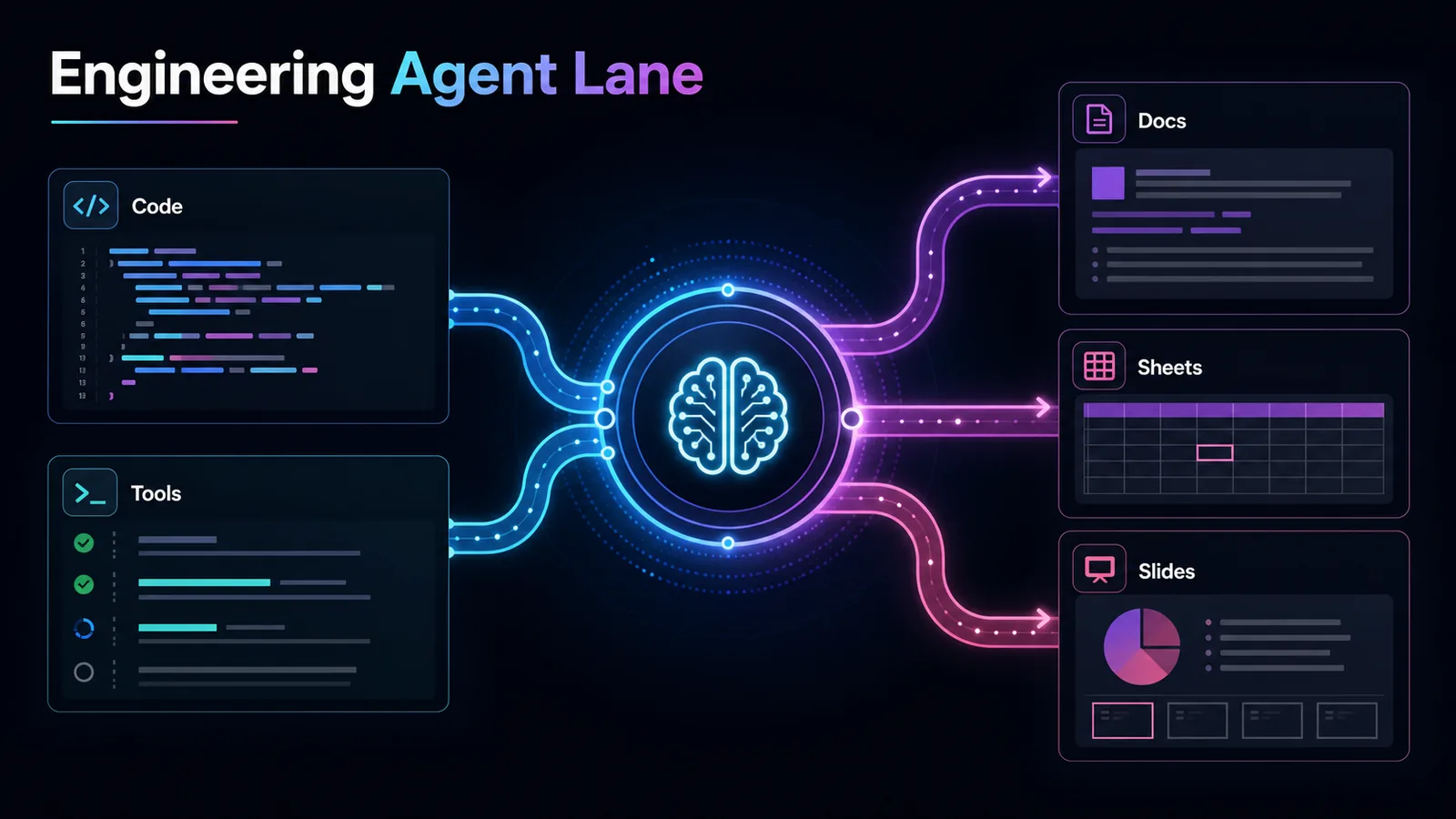
The Operating Levers
The launch package is built around xAI's published numbers and access routes.
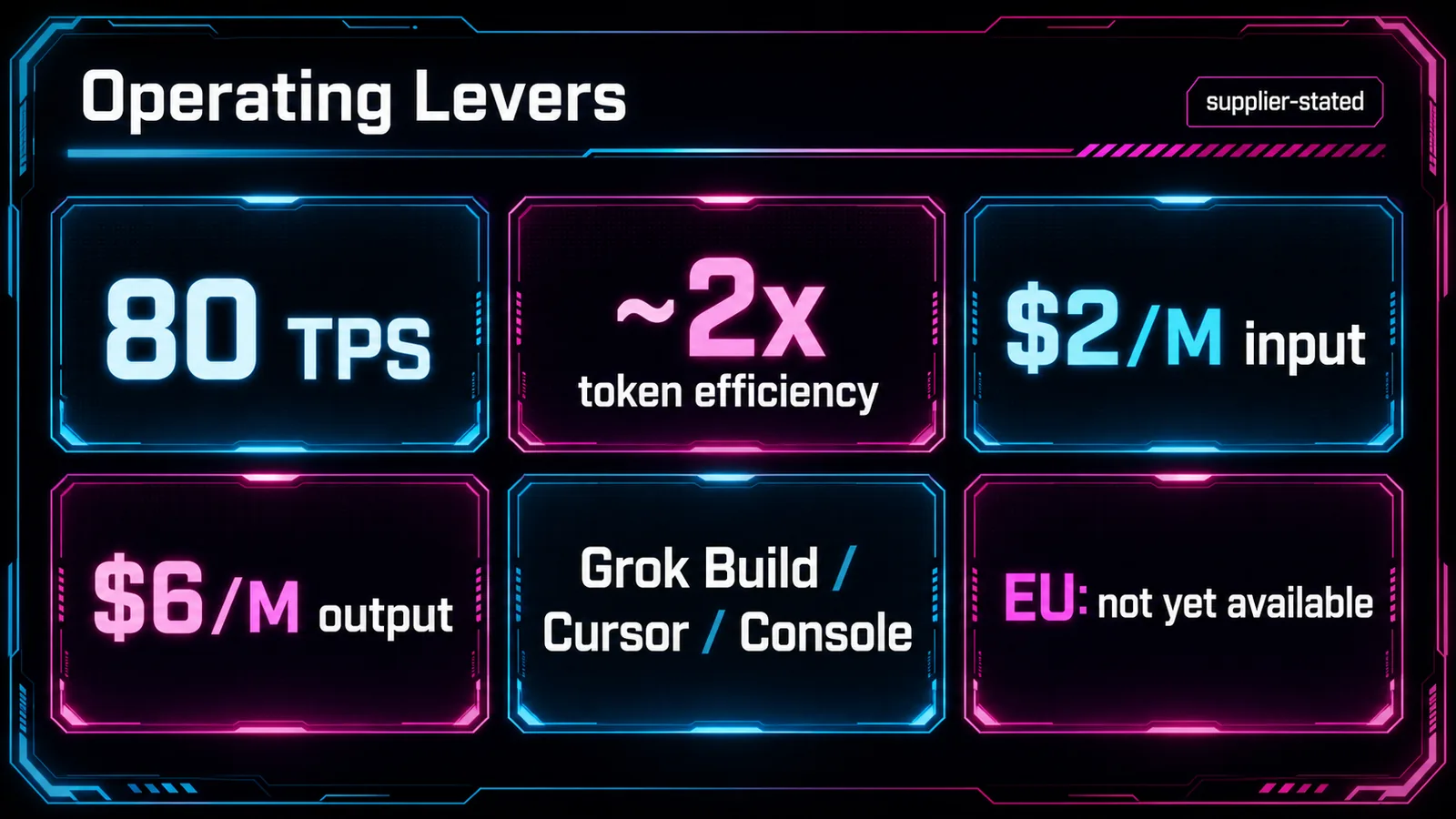
Those details matter because coding-agent work is cumulative. The cost of one prompt is rarely the real cost. The real bill comes from repeated model calls across a task.
There is an important regional limit. xAI says Grok 4.5 is not available in the EU yet.
The Receipt Has Limits
This story rests on xAI material, not independent testing. The provider news page is available through a verified full-page visual capture, with article text recovered through OCR. Raw curl HTML, a Chrome-rendered capture, and a Firecrawl scrape did not recover the article body cleanly because the capture routes hit Cloudflare blocks or an xAI error shell.
That means exact quotation from the provider page needs a final check against the visible screenshot before publication. The xAI-authored X thread is usable within a narrower boundary: the post and same-author thread can support the launch, engineering, pricing, and availability claims, but replies, comments, reaction counts, and quote-post commentary do not support sentiment or adoption claims.
The right reading is simple: xAI has made a clear claim about Grok 4.5. The evidence pack can support that claim as xAI's stated position, with caveats. It cannot turn the launch into an independently verified performance verdict.
What xAI Shows
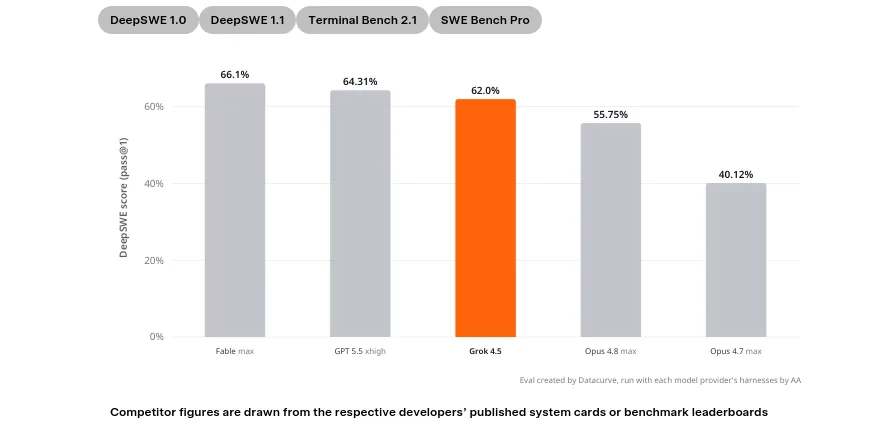
The source pack includes xAI-published visual material around benchmarks, a one-prompt example, an office-work wireframe, an API code block, and an X video thumbnail. Those assets can help show what xAI published, but they do not prove the benchmark results independently, and they are not cleared media assets.
The benchmark chart should therefore be treated as part of xAI's launch presentation. It can explain what xAI is claiming. It cannot stand in for external validation.
The video boundary is also narrow. The thumbnail and manifest exist, but the video itself has not been reviewed for content claims.
How The Coding-Agent Loop Works
The practical story is a loop. We start with a prompt or engineering task. A coding agent has to inspect context, work across files or repositories, produce a change or output, and then return it for human review.
That is why speed and price sit close to capability. A stronger model can still be awkward if every iteration is expensive. A cheaper model can still fail if it cannot follow the task.
The human review step matters. This should not be read as autonomous production shipping.
Where It Is Available
xAI says Grok 4.5 is available through the SpaceXAI console, Grok Build, and Cursor. The Cursor link is part of the launch story because xAI says the model was trained with Cursor and is available there across plans.
The EU caveat should stay visible. The provider page says Grok 4.5 is not yet available in EU SpaceXAI products or the API console and expects availability in mid-July. The xAI-authored X thread says EU availability is expected later this month.
For teams outside the supported regions or channels, the correct takeaway is caution: the launch may be usable through the stated routes, but regional access and API availability still need checking before workflow planning.
The Real Test
The useful question is whether a coding-agent workflow becomes easier to run, cheaper to repeat, and safer to review. That can be tested without treating xAI's launch claims as proven results.
Use a small repository task, keep the scope narrow, and judge the output by reviewability as much as speed.
Copy-paste prompt for a coding-agent test
You are acting as a coding agent inside this repository. I want to test whether you can handle a small, reviewable engineering task without making changes yet.

Task: Inspect the project and identify one narrow improvement that would reduce developer friction. Prefer a failing test, lint issue, unclear setup step, duplicated helper, or small bug-risk if one is visible.

Return a concise review packet with:
1. The specific issue you found and why it matters.
2. The files or commands you inspected.
3. The smallest change you would make, including the exact files you expect to touch.
4. Any assumptions you are making because information is missing.
5. The tradeoffs: speed, token/context use, risk, and whether the change is worth doing now.
6. A verification plan I can run after the change.

Do not edit files, run destructive commands, install packages, commit code, or change configuration. Stop after the review packet and ask for approval before making any change.
What To Watch Next
The next signals are straightforward: independent benchmarks, hands-on developer reports, the EU rollout, cleaner source-media proof, and a reviewed account of any launch video content.
If those pieces line up, Grok 4.5 could matter because it makes coding agents easier to run repeatedly. If they do not, the launch remains a sharp positioning move with unresolved proof and access limits.