GLM-5.3-Flash makes 320B look lean
Z.ai’s new GLM-5.3-Flash pairs a vast parameter count with a much narrower active path—and puts the practical question on cost, not spectacle.

GLM-5.3-Flash arrives with a deliberately striking contrast: 320B total parameters, but 18B active parameters for each request. Z.ai also says the model is natively multimodal and supports a 1M-token context window.
The useful story is not that a larger number has appeared. It is that Z.ai is making a case for doing more with a smaller active slice, at prices that make the claim worth examining.
Efficiency changes the calculation
The architecture and published prices are concrete; the headline performance claims need a narrower reading.

A 320B model that activates 18B parameters suggests an attempt to keep capability and serving cost from moving in lockstep. That matters when we are deciding whether a model is worth trying in a real workflow rather than merely admiring on a chart.
Z.ai’s reported benchmark results remain first-party evidence, not independent validation. The stronger conclusion is simpler: the efficiency proposition is concrete enough to test, while the performance verdict remains open.
Big system, smaller active path
Z.ai is pairing an MIT-licensed model with a 1M-token window and published API rates.

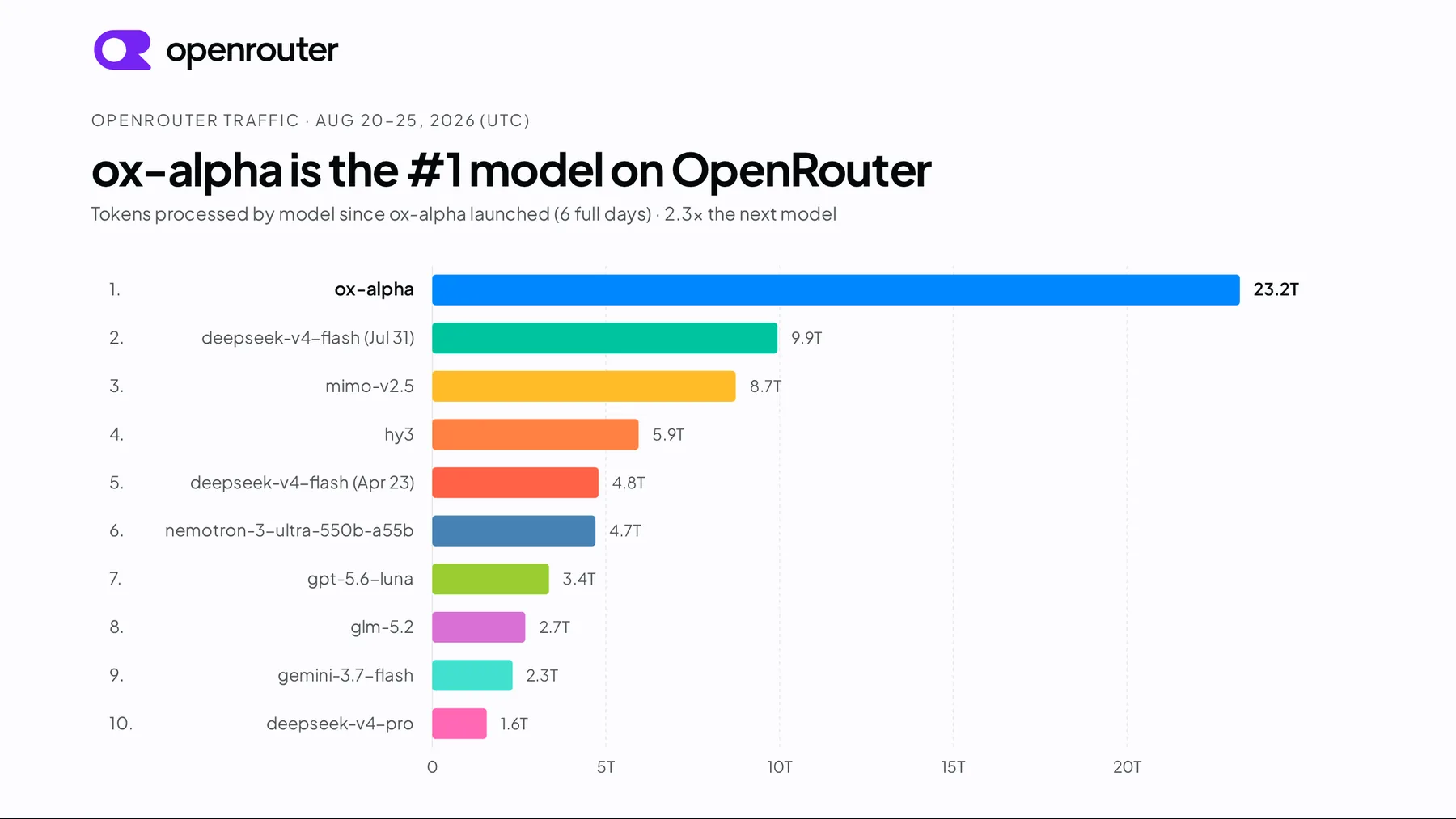
Z.ai publishes standard API pricing of $0.15 for input, $0.50 for output and $0.03 for cached input per million tokens. Those are published prices, rather than comparative benchmarks, and they make the cost side of the release easy to inspect.
The model weights are also publicly available on Hugging Face under the MIT License, according to Z.ai. Access, however, is only the start of the evaluation: practical fit still depends on the tasks we give it and the limits we encounter.
What Z.ai actually announced
The launch wording establishes the model’s stated architecture, context window and access routes.
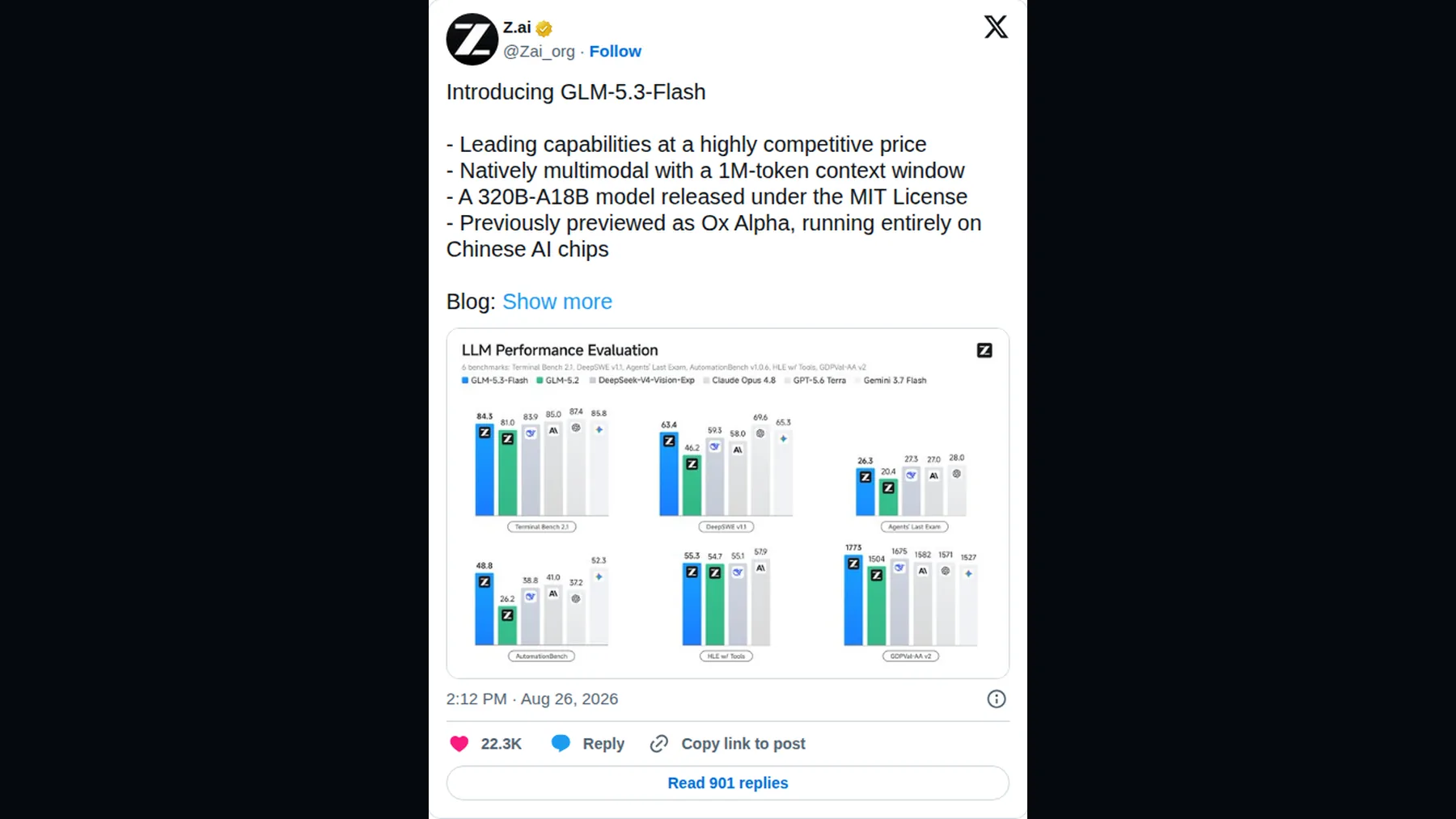
The launch post is useful because it puts the central product facts in one place. Z.ai says GLM-5.3-Flash was previously previewed as Ox Alpha, is released under the MIT License, and is available through weights, API, coding, chat and other official routes.
Those statements establish what is being offered. They do not, by themselves, settle how consistently the model will perform in production or how it will compare under independent evaluation.
Natively multimodal with a 1M-token context window
Z.ai, GLM-5.3-Flash launch announcement
What the charts can prove
Z.ai’s charts show what Z.ai reports; they do not turn an in-house comparison into an independent verdict.
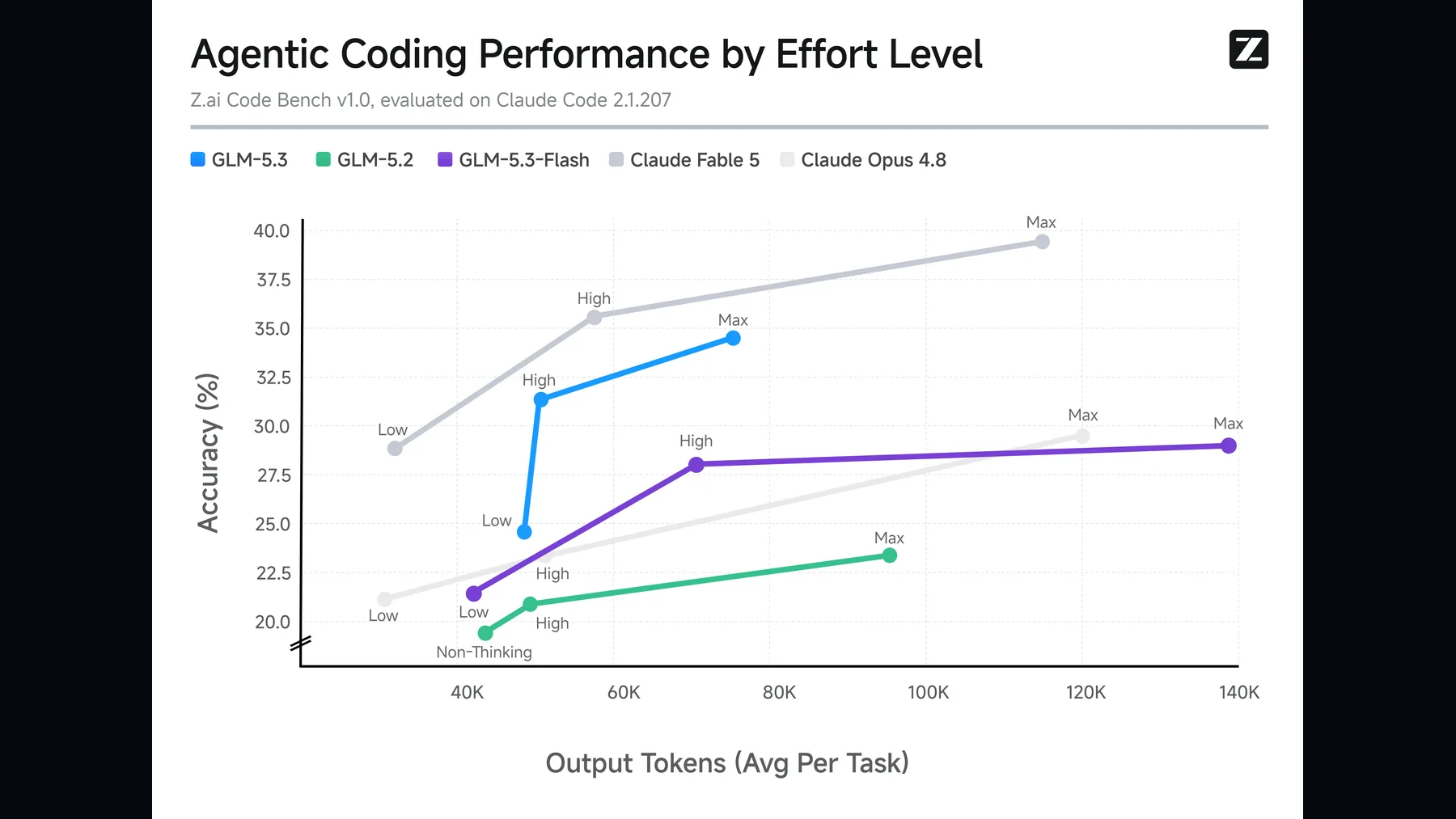
Z.ai says GLM-5.3-Flash outperforms GLM-5.2 at every effort level on Z.ai Code Bench and performs on par with Claude Opus 4.8. That is a specific claim from a named benchmark, and the source makes the comparison legible.
It is not a settled performance verdict. The evaluation is Z.ai’s own, so we cannot infer benchmark superiority, production reliability or parity with another model until independent testing supplies a broader evidence base.
How the model stays lean
Z.ai attributes the efficiency case to a hybrid attention stack and a smaller active-expert path.

The architecture story is about directing computation where it has the most value. Z.ai describes local detail handled through linear attention, selected distant context through sparse attention, and IndexPool compression to keep the context pathway manageable.
Z.ai says the model reduces attention compute by 3.0x and KV-cache size by 4.4x compared with GLM-5.3. Those figures explain the intended mechanism; they are not, on their own, a guarantee of a particular workload outcome.
Local detail
Linear attention handles nearby information without expanding every interaction.
Distant context
Sparse attention selects relevant far-away context rather than treating every token alike.
Active path
A smaller expert set is activated for each request within the wider model.
A loop worth testing
The interesting test is not a leaderboard run, but whether visual inspection and correction hold together in real work.

A useful trial starts with a bounded task: write an interface, render it, inspect the result, then make a specific correction. Native multimodality may help the model reason about what is visible, but we should distinguish that from a claim that it can reliably generate a finished design unaided.
We also need to test the access path we intend to use. Published prices matter, but framework support, rate limits, latency and real serving economics will determine whether the loop remains useful beyond a first demonstration.
Build
Use a bounded coding task with a clear visual and functional target.
Inspect
Compare the rendered result against the stated layout and content constraints.
Correct
Request a focused revision, then verify the change in the next render.
The stack is the story
The durable development is an efficiency proposition we can test, not an independently proven benchmark victory.
The compelling claim is not that the charts have ended the argument. It is that a 320B model may become practical when only 18B parameters carry each request.
Synthesis from Z.ai’s published architecture, launch and pricing materials
Z.ai has put forward a coherent package: a large model, a smaller active path, a 1M-token window, public weights and low published API prices. Each element matters more in combination than as a standalone launch statistic.
The next test is practical and repeatable. We should measure how the model handles real tasks, where the economics hold, and whether independent evaluation changes the current picture.
Test a multimodal coding loop
Act as a senior front-end engineer. Create a concise implementation plan for a product page that lets us upload a desktop screenshot, identify the three most visible layout faults, and return corrected HTML and CSS. Preserve the page’s existing content, use semantic HTML, keep the layout responsive from 375px to 1440px, and finish with a three-item visual QA checklist. Output: 1) findings, 2) implementation plan, 3) complete code, 4) QA checklist.Ready to copy
Test the efficiency claim
Run one bounded workflow, record cost and output quality, then compare the result with an alternative model under the same conditions.
Try the promptWhat could change the view
- Independent benchmark results
- Production reliability evidence
- Framework support
- Observed serving economics