Gemma 4 26B A4B’s Mac speed jump needs a receipt
Google Gemma says community work around mlx.fast has made Gemma 4 26B A4B faster on Apple Silicon. The missing test recipe matters as much as the claim.

Google Gemma says running Gemma 4 26B A4B on a Mac has become “2x faster”. That is an attention-grabbing claim, but the more useful part of the announcement is who it credits: developers working around the mlx.fast leaderboard and pushing Apple Silicon further.
The post gives us a reason to watch local AI more closely. It does not yet give us enough to treat the result as a broadly reproducible benchmark.
Why faster local AI matters
Responsiveness changes what we are willing to try locally, but only a repeatable setup can show whether that change is real for us.

When a large model responds slowly, each experiment carries more friction. A reported speed improvement can make the next test feel more viable—not because it guarantees a particular outcome, but because it changes the prospect of iteration.
That distinction matters. Google Gemma’s post is about Gemma 4 26B A4B on Apple Silicon, not every model, every Mac, or every local workflow.
What the post says—and leaves out
The announcement contains two striking speed phrases, but neither arrives with the details needed to reproduce or compare them.
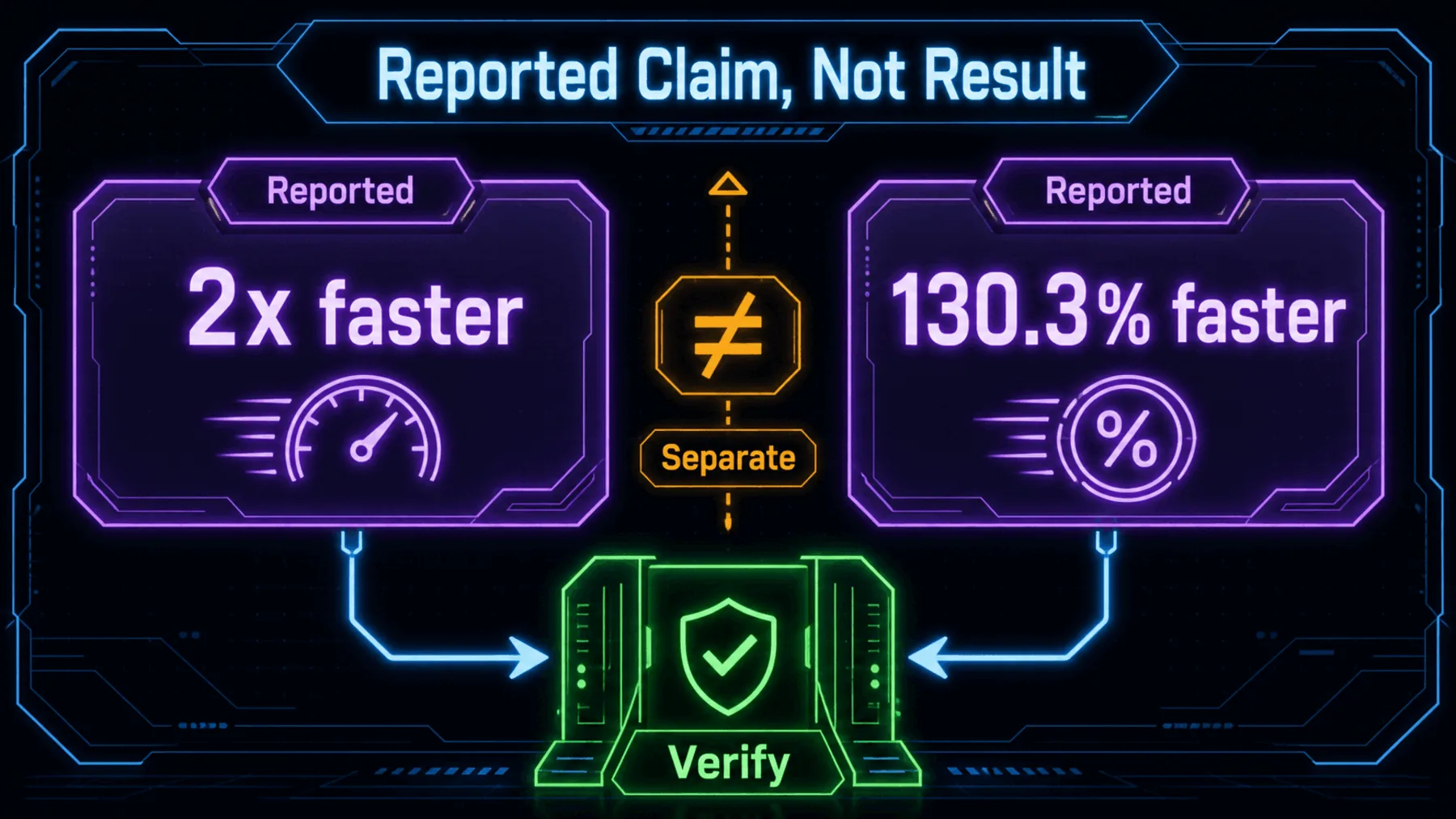

The two figures should remain separate. Google Gemma’s post uses “2x faster”, while the attached visual says “130.3% faster on Mac”. We do not have the baseline, method, or exact run behind either statement, so there is no sound basis for reconciling them.
That is not a reason to dismiss the announcement. It is a reason to ask for the receipt before turning a promising post into a settled performance claim.
Google Gemma’s exact claim
The post is clear about the model, the Mac context, and the community effort it credits.
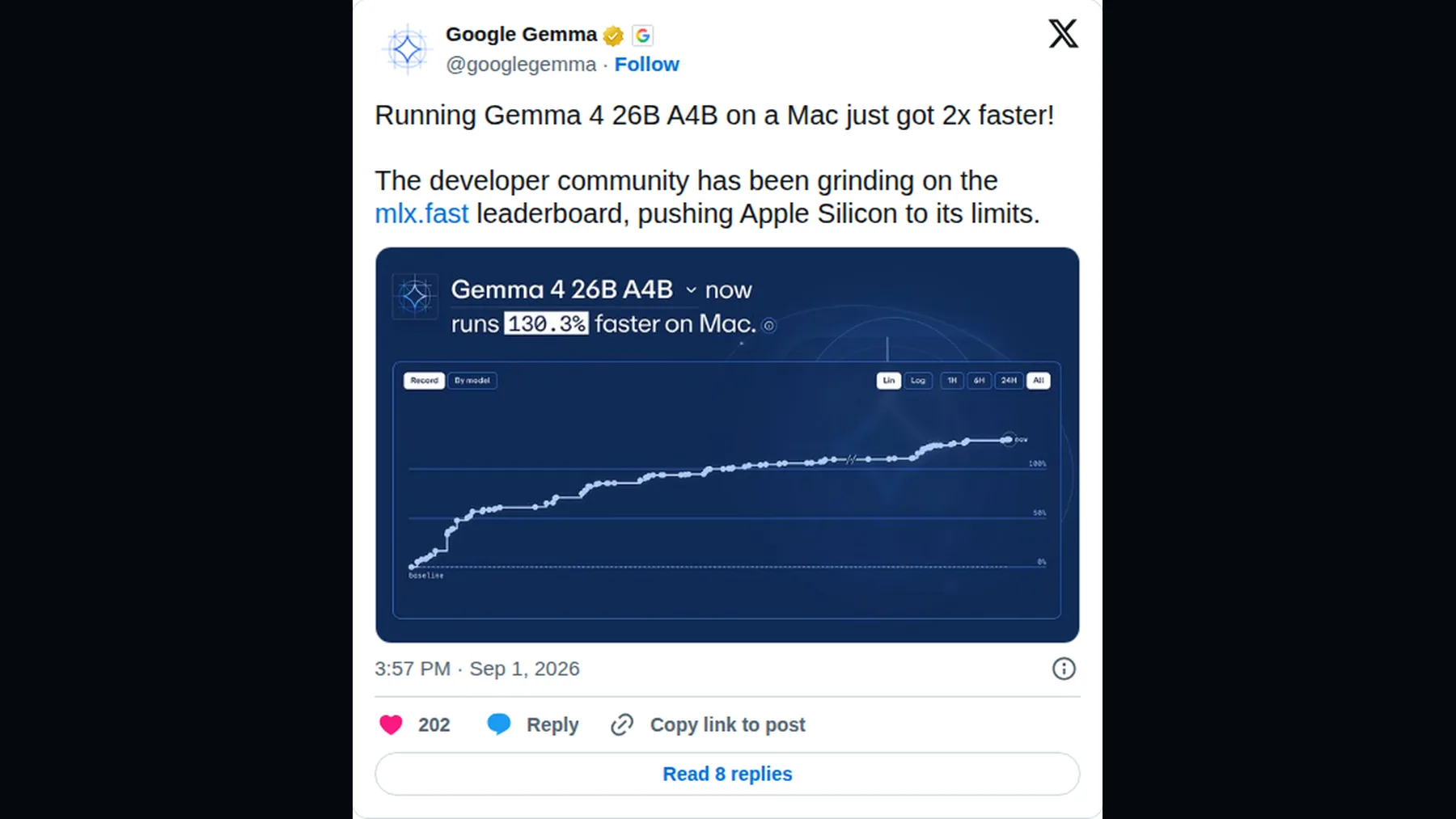
Google Gemma frames this as an optimisation story, not a new-model launch. The named model is Gemma 4 26B A4B, the stated environment is a Mac, and the post points to developer work around the mlx.fast leaderboard.
That gives the claim a specific boundary: Apple Silicon and this model label. It does not establish a result for other hardware, other Gemma models, or every Mac configuration.
The developer community has been grinding on the mlx.fast leaderboard, pushing Apple Silicon to its limits.
Google Gemma on X
The chart cannot prove the benchmark
The supplier image strengthens the claim’s visibility, not its reproducibility.
The image adds a second supplier-reported phrase: “130.3% faster on Mac”. It also presents a rising trend. What it does not show is the benchmark context that would let us evaluate the result.
A chart can make a claim memorable. It cannot substitute for the configuration, comparison and measurement record that makes a performance result checkable.
How community tuning moves the needle
The notable shift is the work around an existing model, with verification still at the end of the path.

Google Gemma credits the developer community for grinding on the mlx.fast leaderboard. That is the momentum in this story: effort around the environment in which an existing large model runs, rather than a claim that the model itself has changed.
The practical implication is promising but conditional. Community optimisation can move the experience forward; our own configuration and a documented test determine whether it moves forward for us.
What we can test next
Start with the exact model and Apple-Silicon boundary, then make the setup visible before drawing a wider conclusion.
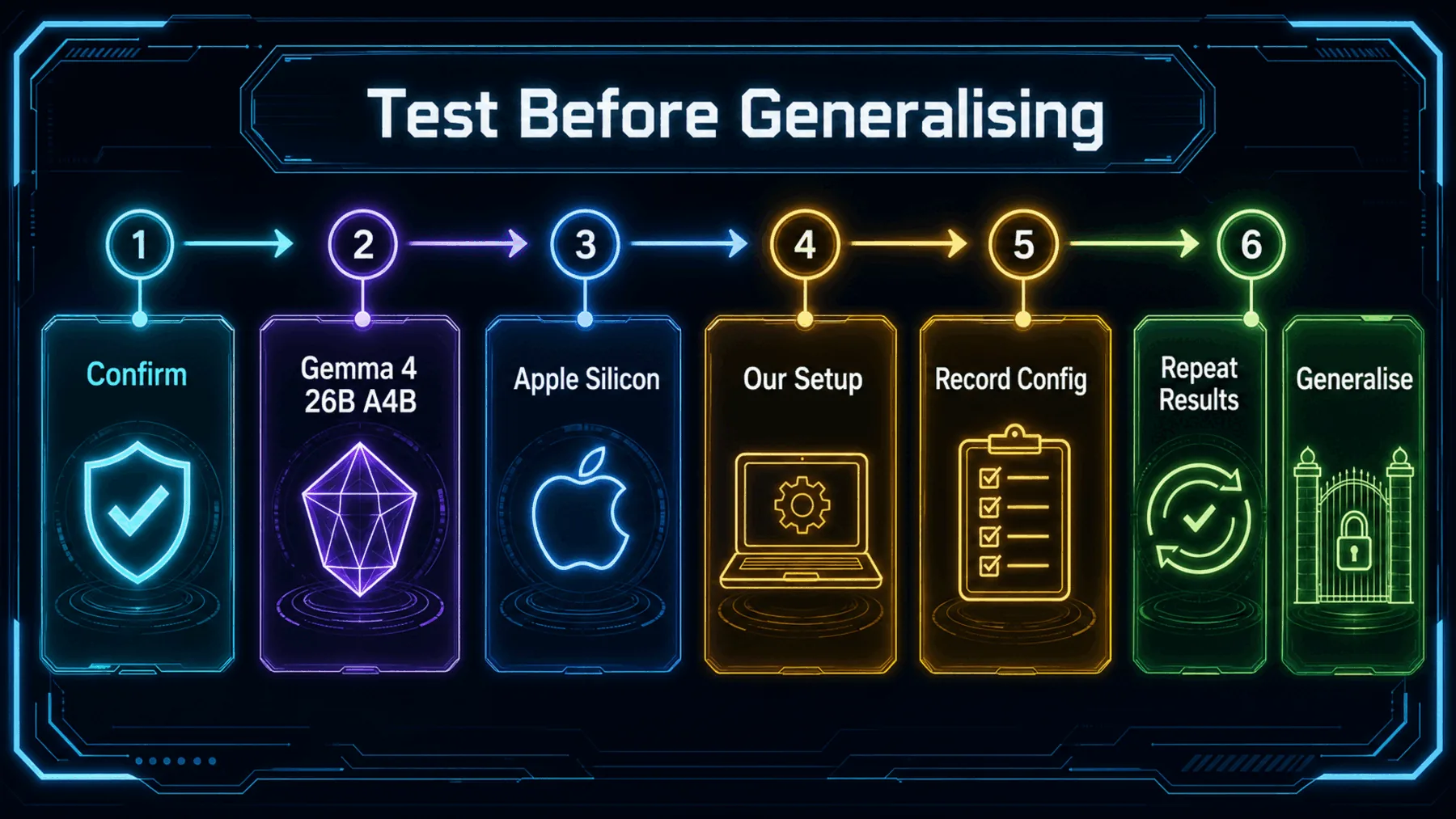
We can begin by confirming that our test matches the stated scope: Gemma 4 26B A4B on Apple Silicon. From there, the useful work is ordinary and disciplined—record the configuration, use a repeatable workload, and keep the observations with the setup.
If the result looks encouraging, repeat it before generalising. That preserves the excitement of a possible speed jump without borrowing certainty the source has not supplied.
The real shift is community speed
The announcement matters because optimisation work can change the practical feel of local AI before a new model arrives.
The interesting change is not that a new model appeared. It is that community optimisation may be changing the pace at which an existing one becomes practical to test.
Synthesis from Google Gemma’s 1 September 2026 post
The strongest reading is also the cautious one. Google Gemma has supplied a specific, supplier-reported speed claim and attributed the momentum to community work around mlx.fast. That is worth following.
What remains open is the receipt: the exact setup and measurement record that would let us move from a compelling announcement to a result we can compare on our own Mac.
Make the benchmark receipt explicit
Act as a rigorous local-AI test reporter. For Gemma 4 26B A4B on Apple Silicon, turn one repeatable test run into a compact benchmark receipt. State the Mac chip, model version, software configuration, comparison baseline, prompt or workload, measurement unit, number of runs, and exact mlx.fast leaderboard entry if available. Separate observed results from assumptions, and end with a three-line table: setup, result, limitation.Ready to copy
Watch the receipt, then test
Treat the reported gain as a useful signal, not a universal conclusion: keep the model, Apple-Silicon boundary and missing benchmark details together before we generalise.
Try the promptWhat would make the claim checkable
- Comparison baseline
- Apple chip and configuration
- Protocol and unit
- Exact leaderboard entry