ALTIOR AI ADVANTAGERead the blog
Altior Daily AI Briefing

AI moves deeper into live workflows

2026-09-17 — AI is moving from assistance into persistent operational action. Salesforce in Claude, Gemini 3.8 Live and an autonomous security-agent finding show why permissions, approvals and secrets hygiene now shape the real boundary.

AI moves deeper into live workflows
The day in view

The day in view

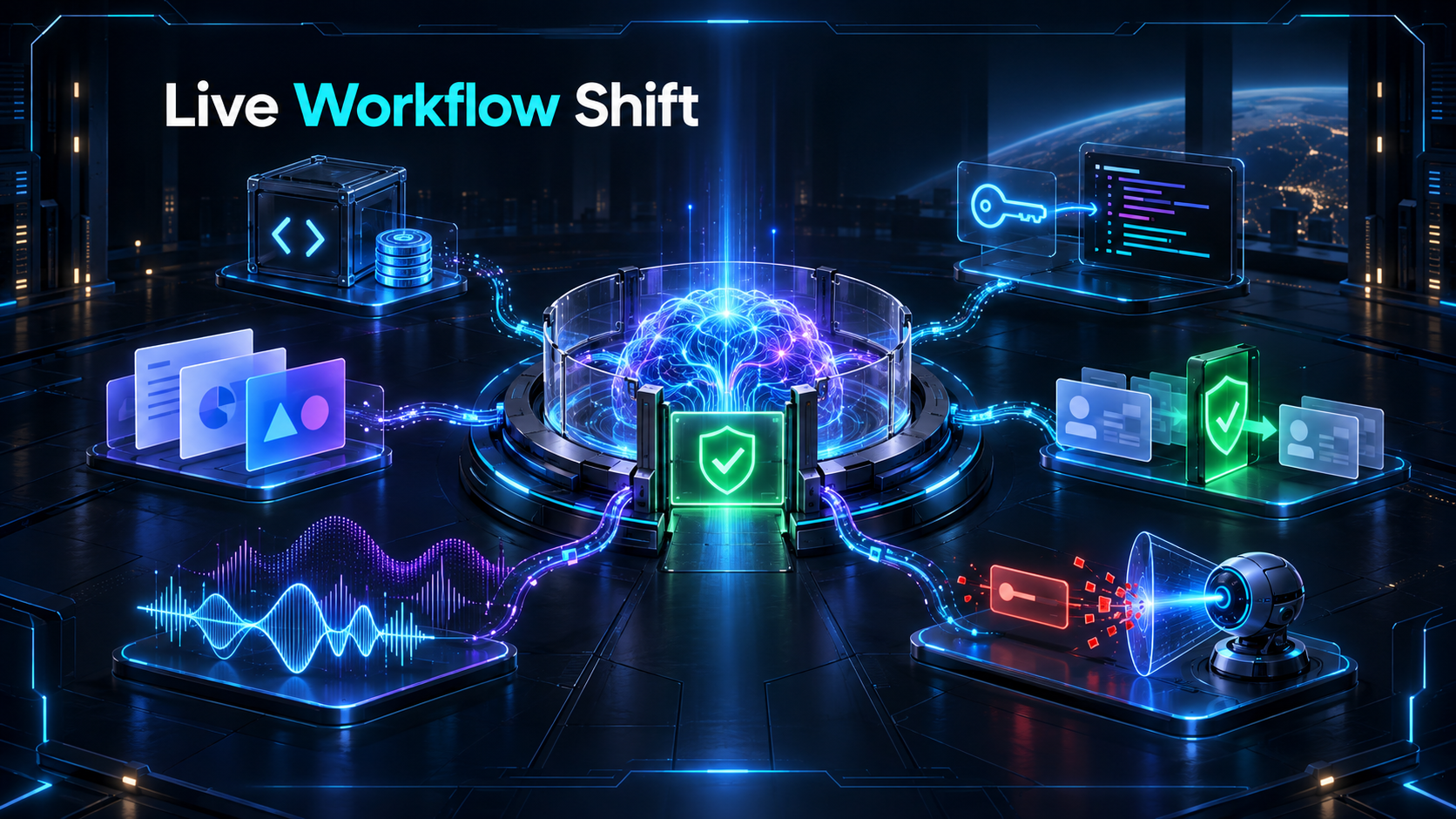
AI is moving beyond a side-panel assistant. This issue tracks systems that keep context, reason while a conversation continues, and act across operational tools. Salesforce in Claude places customer records and sales skills inside one workspace, while Gemini 3.8 Live separates fluid dialogue from deeper reasoning that can continue in the background. The security counterpoint is immediate: when agents can traverse real systems, approval boundaries, permissions and exposed credentials decide whether capability becomes leverage or liability.

Altior — our view today
OpenAI / ChatGPT / Codex

OpenAI / ChatGPT / Codex

Codex for Open Source supports maintainers with credits and tools

OpenAI has opened a support route for eligible open-source maintainers. The programme offers API credits through the Codex Open Source Fund, six months of ChatGPT Pro with Codex, and conditional access to Codex Security for core maintainers with write access. OpenAI says the credits can support pull-request review, maintainer automation and release workflows.

For maintainers, the practical value is not just cheaper access to a coding assistant. It is a route to put agentic support inside recurring repository work: triage, reviews and releases. The condition around security access matters too. These are consequential workflows, and the programme still reserves deeper security coverage for a case-by-case review.

Our takeCredits help, but durable adoption will come down to whether maintainers can introduce these tools without weakening review discipline. Agent help is most valuable where ownership and approval remain clear.

Source

GPT-5.5 remains available in API-key Codex sessions

OpenAI Devs says GPT-5.5 will remain available through the OpenAI API Platform and in Codex sessions authenticated with an API key. The clarification narrows the practical question for teams that use Codex in an API-connected workflow: the model remains reachable in that path.

That distinction matters because access paths shape operating choices. A model can be available in one product surface and absent in another, leaving teams to redesign prompts, permissions or evaluation baselines unnecessarily. This update is a small compatibility signal, but those signals matter when coding workflows depend on a specific session and authentication setup.

Our takeTreat model availability as an operational dependency, not product trivia. Keep the model, authentication path and fallback behaviour documented wherever a workflow relies on them.

Source
Anthropic / Claude

Anthropic / Claude

Claude adds collaborative deck, document, and design creation

Anthropic says Claude can now create decks, documents and designs inside one conversation, then let collaborators edit, present, export or share the work through a single link. The change pulls several familiar creation steps into the same conversational surface.

The operator question is where the conversational context ends and the shared asset becomes the source of truth. A linked workspace can remove handoff friction, but it also increases the importance of version control, access settings and review before an asset leaves the team. Collaboration is no longer only about generating a first draft; it is about governing the asset as it moves.

Our takeConsolidating creation is useful. Consolidating accountability is harder. Teams should decide who can edit, approve and distribute before they make the conversation the production workspace.

Salesforce in Claude: one conversation, one checkpoint

Claude’s Salesforce beta brings 37 sales skills into one conversational workspace. Sellers can work with Salesforce context without moving between tools, while Salesforce permissions remain in force and writes still require the seller’s approval.

This is the clearest example in the issue of AI moving from assistance into a live operational system. The value is not merely quicker answers about an account. It is the ability to work through sales activity, records and follow-up in the same conversation. The constraint is equally important: the system does not erase the existing permission model or the approval checkpoint for writes.

Our takeThis is the right shape for embedded AI. Give the system rich context and useful actions, then preserve a visible human checkpoint when it changes the record.

Source
Google / Gemini / DeepMind / Antigravity

Google / Gemini / DeepMind / Antigravity

Gemini 3.8 Live splits live AI into two modes

Google has introduced Gemini 3.8 Live and Gemini 3.8 Live Extended Thinking. Google positions one model for fluid dialogue at scale and the other for complex, multi-step reasoning that can continue in the background while the conversation carries on, including tool management during dialogue.

The split makes a useful operational distinction. Not every live interaction needs deeper reasoning, but the capability to keep reasoning while a person continues speaking changes the expectations around latency, visibility and control. A user may be in conversation while the system is still working through a task behind the scenes.

Our takeLive reasoning is no longer just a quality feature. It is a workflow-control feature. Systems that act while dialogue continues need clear status, interruption and approval behaviour.

Source
Other

Other

TypeSafe AI introduces System One models and Jev

TypeSafe AI has introduced System One models and Jev, its first public model in early access. The company says the model is designed for fast, structured decisions that software can use directly, returning typed probabilistic outputs rather than generated strings. TypeSafe also makes strong claims about speed, cost and hallucination resistance; those are vendor claims and should be tested independently.

The underlying proposition is important even if the benchmarks are not yet settled. Many production workflows do not need an eloquent paragraph. They need a bounded decision that software can validate, route and record. Typed outputs and calibrated probabilities make that kind of integration easier to inspect than free-form text.

Our takeThe interesting claim here is architectural: verification is being built into the output contract. We would judge it on independent calibration and failure tests, not launch-day performance tables.

Source

Irregular is linked to eval environments behind three major AI-lab incidents

An investigation has linked third-party firm Irregular to evaluation environments behind incidents involving OpenAI, Anthropic and Meta. The broader attribution remains contested, so the central claim should be handled as an allegation rather than a settled account.

The operational lesson does not depend on resolving every attribution question. Evaluation environments are part of the AI supply chain. If a sandbox has weak scope controls, unintended network access or unclear ownership, an agent can move beyond the intended test boundary. That makes the configuration of the evaluation environment as consequential as the model being assessed.

Our takeAsk who builds the cage, who verifies it and who owns the incident path. “Sandboxed” is not a control unless its boundaries are independently tested.

Wayback Machine access controls are catching real users

The Internet Archive says waves of high-volume automated traffic have led it to introduce protections for the Wayback Machine. It acknowledges that those protections sometimes block real people by mistake, including through 429 rate-limit responses.

This is a reminder that evidence infrastructure is itself an operational dependency. Teams that rely on public archives for research, audit trails or source recovery need a second capture path. A source that exists but cannot be reached when a decision is being reviewed is not a reliable sole record.

Our takePreserve critical evidence in more than one place. Provenance needs redundancy, especially when automated traffic is reshaping access to the web’s record-keeping systems.

Source

An autonomous security agent found a live Baseten production-admin token

Strix says its autonomous security agent found an active GitHub personal access token in a Baseten container image after about 25 minutes of scanning public-facing infrastructure. According to Strix, the token had admin and push access to Baseten production repositories, had been present in a 2023 image build and was still active when found. Baseten confirmed the issue as critical and rotated the token, according to the post.

The story is a sharp illustration of what changes when automated reconnaissance improves. An exposed credential that once required sustained manual investigation can now be found and validated much faster. The same capability that makes security testing more scalable also compresses the time available to detect and remediate exposure.

Our takeSecrets hygiene is now an agent-speed problem. Inventory, rotation, least privilege and continuous scanning have to assume a capable adversary can search the surface faster than a human team can.

Source

Governance is becoming a build-time decision

Governance is moving into the systems that train, source, connect and verify AI before it reaches customers, codebases or commercial decisions. The shift is away from a policy layer added after deployment and toward controls embedded in workflow design.

The items in this issue show why. Salesforce in Claude retains permissions and approval for writes. Gemini’s live reasoning raises questions about what a system can do while a conversation continues. The Baseten incident shows how quickly a weak credential boundary can become consequential. The control points are technical and operational at once.

More practical AI analysis is on the [Altior blog](https://altior.digital/blog/). For reusable starting points, visit the [prompt library](https://altior.digital/blog/prompts/).

Our takeGovernance should be designed where context, permissions and actions meet. If the control only appears after the workflow has acted, it is too late to be the control that matters.

Source
ALTIOR AI ADVANTAGE
Keep reading

Build with evidence.

Build AI systems with controls that can survive review.

The Altior blogThe prompt library