ALTIOR AI ADVANTAGERead the blog
Altior Daily AI Briefing

Specialist AI Is Becoming the Product Surface

11 September 2026 — Financial analysis, scientific work, web deployment, fast inference and coding are being packaged as distinct AI products.

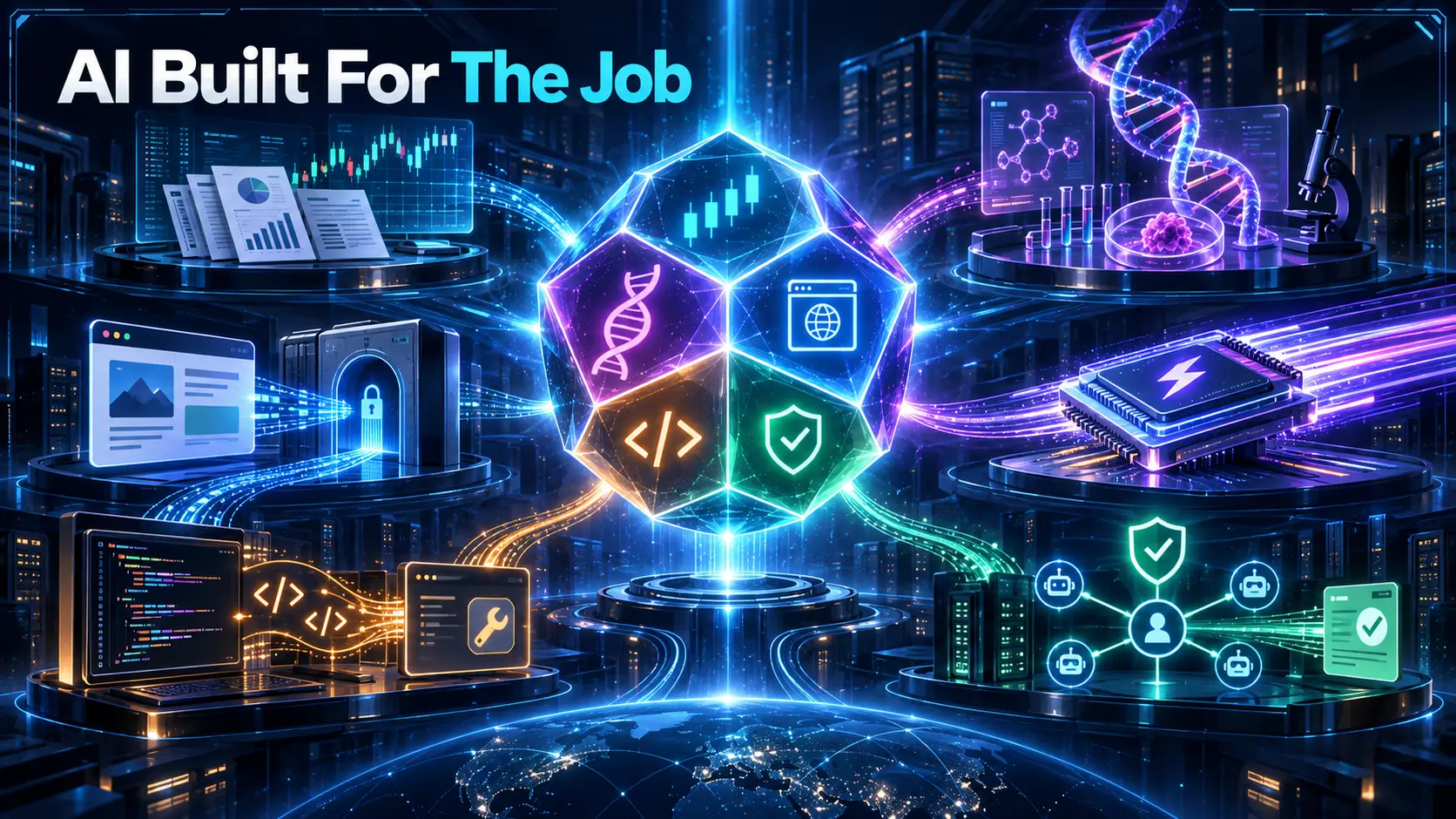
An abstract illustration of specialist AI systems arranged around distinct professional jobs.
The week in view

From general chat to purpose-built systems

The question is no longer just which model sits behind the interface. It is which job the system is built to own.

Altior — our view this week

The story this issue is product surface. AI is being packaged around work that carries a consequence: financial analysis, scientific work, site deployment, fast inference and software engineering. ChatGPT for Financial Services, GPT-Rosalind, ChatGPT Sites, DeepSeek V4.1-Flash and SWE-2 point in the same direction.

That shift matters because the layer around the model becomes part of the offer. Data, tools, review paths, deployment, collaboration and the boundary of what gets automated all shape the result. We can see it in citation previews, managed agents and on-call diagnosis, too.

We are watching the practical detail: whether the specialist surface gives operators a clearer workflow, or simply a narrower wrapper around generic capability. There is a real difference. This issue maps the releases across that line.

OpenAI / ChatGPT / Codex

The model becomes the work surface

ChatGPT for Financial Services

ChatGPT for Financial Services is now available as a tailored ChatGPT Work experience. It combines built-in financial data with GPT-6 Astra’s reasoning. The point is not a generic chat window pointed at a finance team. It is a product surface shaped around financial analysis, where the data and reasoning layer are presented as one working environment. That is a meaningful packaging decision for a regulated, high-consequence job.

Our takeWe should judge the value in the workflow, not the label. A specialist surface only earns its place if it gives the operator a clearer route from analysis to a reviewable outcome.

Source

ChatGPT Sites adds collaboration, private sharing, and custom domains

ChatGPT Sites has passed 5 million sites created since launch and added team collaboration, private sharing, faster deployment, database inspection and custom domains. These are operating features, not just generation features. They move the product from making a page towards sharing, inspecting and deploying a site with other people involved. That makes the site itself the job-shaped surface, rather than a one-off output from a general model.

Our takeThe important signal is the workflow around creation. Collaboration and deployment are where a generated site becomes something a team can actually operate.

GPT-Rosalind exits research preview

GPT-Rosalind is now out of research preview for eligible organisations worldwide. It is available through the API, Codex and ChatGPT Enterprise, with further models due to be added as they are released. The release puts a scientific-work model into the same routes that organisations use to build, code and operate. That is a direct example of a model being made available around a distinct professional job, rather than held apart as a research demonstration.

Our takeAvailability is not the same as a finished operating system. But putting the model into API, Codex and Enterprise routes is the right test: can specialist capability travel into real work?

Citation passage previews expose the evidence behind analysis

Citation passage previews let users trace figures and claims back to specific paragraphs and tables, then preview the supporting passage from the citation. This is a small product feature with a large operational implication. Analysis is more useful when the reader can inspect the evidence without leaving the work. It makes the evidence trail part of the interface, not a separate task after the answer has already persuaded someone.

Our takeThis is the kind of surface detail that matters. We want the claim and the supporting passage close together, because review is part of the job.

Source

OpenAI launches the Agents API for managed Codex agents

OpenAI has launched the Agents API for building and running cloud agents with the Codex harness, fully managed by OpenAI. The product is aimed at shortening the route from an idea to a working agent. It packages the harness, hosting and runtime around the job of building an agent, rather than handing an operator only a model endpoint and asking them to assemble the rest.

Our takeManaged infrastructure can remove real setup work. The operational question is whether the managed layer makes the agent easier to inspect and control once it is doing consequential work.

Source
Anthropic / Claude

Control becomes part of the product

Anthropic publishes its most detailed threat-intelligence report

Anthropic published what it describes as its most detailed threat-intelligence report, covering attempts to misuse Claude for cyberattacks, influence operations, surveillance and biology. The report puts the misuse environment alongside the model itself. That is useful context for operators because capability is never the whole story: where a system is used, how it is connected and what it can reach all change the risk profile.

Our takeA serious threat report belongs in the operating picture, not a separate safety drawer. The useful question is what controls and review paths sit around the capability.

Source

Claude Managed Agents adds auto mode

Claude Managed Agents has added auto mode. Claude reviews each tool call against the intent in user.message events and decides whether to run the call. This puts a decision point between a proposed action and the action itself. It is a purposeful product layer around agent operation, where the system is expected to interpret the user’s intent before it invokes a tool.

Our takeThis is a useful direction because tool calls are where agent work becomes real. We would look closely at how the intent check behaves when the task and the action do not line up.

Source

Claude Code adds plugin evaluation

Claude Code now supports plugin evaluation: create test cases, run a plugin or skill against those cases, score the runs, then repeat the cases without the plugin to compare the difference. The feature turns evaluation into part of the development loop. It is not just a model story; it is a product surface for deciding whether a plugin or skill changes the work in a useful way.

Our takeThe comparison run is the important part. A plugin should be able to show what it improves, rather than relying on a persuasive demo.

Claude Tag is used for on-call diagnosis and proposed fixes

Claude Tag is being used for on-call work. When an alert fires in Slack, it pulls metrics, diffs deploys and checks flags, then finds a likely cause and proposes a fix for the team to approve and merge. That sequence packages a model around a distinct operational job: diagnosis with a human approval point at the end.

Our takeThis is a better shape than an agent that acts without a clear handoff. Diagnosis and proposal are useful; approval and merge remain the team’s decision.

Google / Gemini / DeepMind / Antigravity

The surface reaches into daily systems

Android adds direct password and passkey transfers

Android has added a feature for securely transferring passwords and passkeys between password managers without file downloads. It is not an AI-model launch, but it is a reminder that useful software surfaces are defined by a specific job and a specific constraint. Here the job is moving credentials, and the product is designed to remove the file-based handoff from that path.

Our takeThe best product surfaces reduce awkward steps in a consequential workflow. Credential movement is exactly where clarity and fewer handoffs matter.

Source

Dreambeans opens to all adult US users

Dreambeans is now available to all US users aged 18 and over on iOS and Android. It is free of charge and does not require a subscription. The launch expands access through two familiar mobile surfaces. Whatever the product’s use case, the distribution decision is clear: place it where people already work and create, then remove the subscription gate for the eligible audience.

Our takeAvailability is a distribution signal, not a verdict on utility. We will judge the product by the job it helps users do once it is in their hands.

Source
DeepSeek

Efficiency gets its own surface

DeepSeek introduces V4.1-Flash

DeepSeek introduced DeepSeek-V4.1-Flash as smarter, faster and more efficient. The announcement makes efficiency the product proposition, not a background technical attribute. That belongs in this issue because fast and efficient inference is a distinct operational job: teams need a model that fits the cost and latency shape of the work, not simply the most general capability available.

Our takeThe claim is DeepSeek’s. The operational test is straightforward: whether the speed and efficiency hold up in the workloads that need them.

Source
OpenClaw

Release state needs a clear surface

OpenClaw 2026.9.4 exposes the gap between package availability and release certification

For OpenClaw 2026.9.4, the signed tag appeared at 01:53:52Z and npm latest moved at 02:44:59Z. At the briefing close, the GitHub release object, documentation and changelog still certified 2026.9.3. This is an operational product-surface issue in its own right. A package can be available while the release state a team can safely rely on has not yet been fully certified across the visible record.

Our takeWe need release state to be legible. Package availability and certification are different signals, and an operator should not have to infer the difference.

Source
Other

The market is splitting by job

Cognition launches SWE-2 into the coding-model race

Cognition launched SWE-2 and claimed frontier coding parity. A third-party aggregator reported a 92.8 result on Terminal-Bench 2.1, while independent replication was thin at report time. This is a coding-specific product claim, and it belongs in the specialist-AI story because the model is being framed around software-engineering work rather than generic conversation.

Our takeThe claim is worth tracking, but the evidence is not complete. We should separate the launch framing from independently replicated performance.

Source

Anthropic’s distillation allegations turn model provenance into a market story

Anthropic detailed distillation campaigns it attributed to Alibaba, Moonshot AI and DeepSeek. The allegations move model provenance from a technical concern into a market story. As models are packaged around distinct jobs, operators also need to understand what sits behind the capability they are being asked to adopt and how those claims are being contested in public.

Our takeProvenance is now part of product evaluation. We should treat allegations as allegations, while recognising that the question of model lineage matters to buyers.

Source

OpenAI’s unpublished-math dispute keeps model trust on the front page

A live Hacker News capture showed the discussion “More questions about whether researchers can trust OpenAI with unpublished math” at 752 points. The signal is not a technical finding by itself. It is evidence that trust in how models handle sensitive, unpublished work is a live concern for the people deciding where specialist AI can safely be used.

Our takeA model aimed at serious work has to earn trust in its handling of serious inputs. Attention alone does not resolve the dispute, but it shows why the question matters.

Source

Shopify moves from React Native back to Swift and Kotlin

Shopify is moving from React Native back to Swift and Kotlin. The reversal puts platform-owned dependency choices under scrutiny. It sits beside the AI story because specialist systems do not live alone: their value depends on the stack around them, and teams still have to decide which layers they want to own directly.

Our takePurpose-built does not mean dependency-free. The operating choice is still about where control, performance and maintenance should sit.

Source

Rust becomes a tier-1 language at Microsoft

Rust is now a tier-1 language at Microsoft as systems-language consolidation continues. This is not a model announcement, but it is part of the same operating backdrop. AI products that promise specialised work still run on infrastructure, and language choices shape the systems teams can maintain, secure and extend underneath the visible product surface.

Our takeThe durable story is not novelty. It is the stack becoming more deliberate about the foundations it expects teams to operate.

Source

Forgejo patches a critical remote-code-execution flaw

Forgejo versions through 16.0.3 were affected by a critical remote-code-execution flaw, fixed in 16.0.4. The item is a direct reminder that a specialist workflow is only as usable as the systems around it are safe to operate. Coding, agents and deployment all depend on basic release and patch discipline holding underneath the product experience.

Our takeNo product surface is above patch hygiene. A critical fix is an operator action, not background news.

Source

A community model-authenticity probe reaches 354 stars in its first day

cek-probe-model reached 354 stars in about 26 hours. The project signals demand for tools that test whether a model is masking its identity. As the market splits into purpose-built offers, model authenticity becomes a practical question: operators need to know what capability they are actually interacting with before they build it into a workflow.

Our takeThe star count is a signal, not proof of the tool’s quality. But the demand is clear: model identity is becoming an operational concern.

Source
ALTIOR AI ADVANTAGE
Keep reading

Follow the work, not just the model name

Read more on the Altior blog, or use the prompt library to turn a clearer job into a clearer brief.

The Altior blogThe prompt library