ALTIOR AI ADVANTAGERead the blog
Altior Daily AI Briefing

Persistent Agents Need Operating Contracts

9 September 2026 — OpenAI and Anthropic show why persistent agents need bounded authority, evidence trails and recoverable operations.

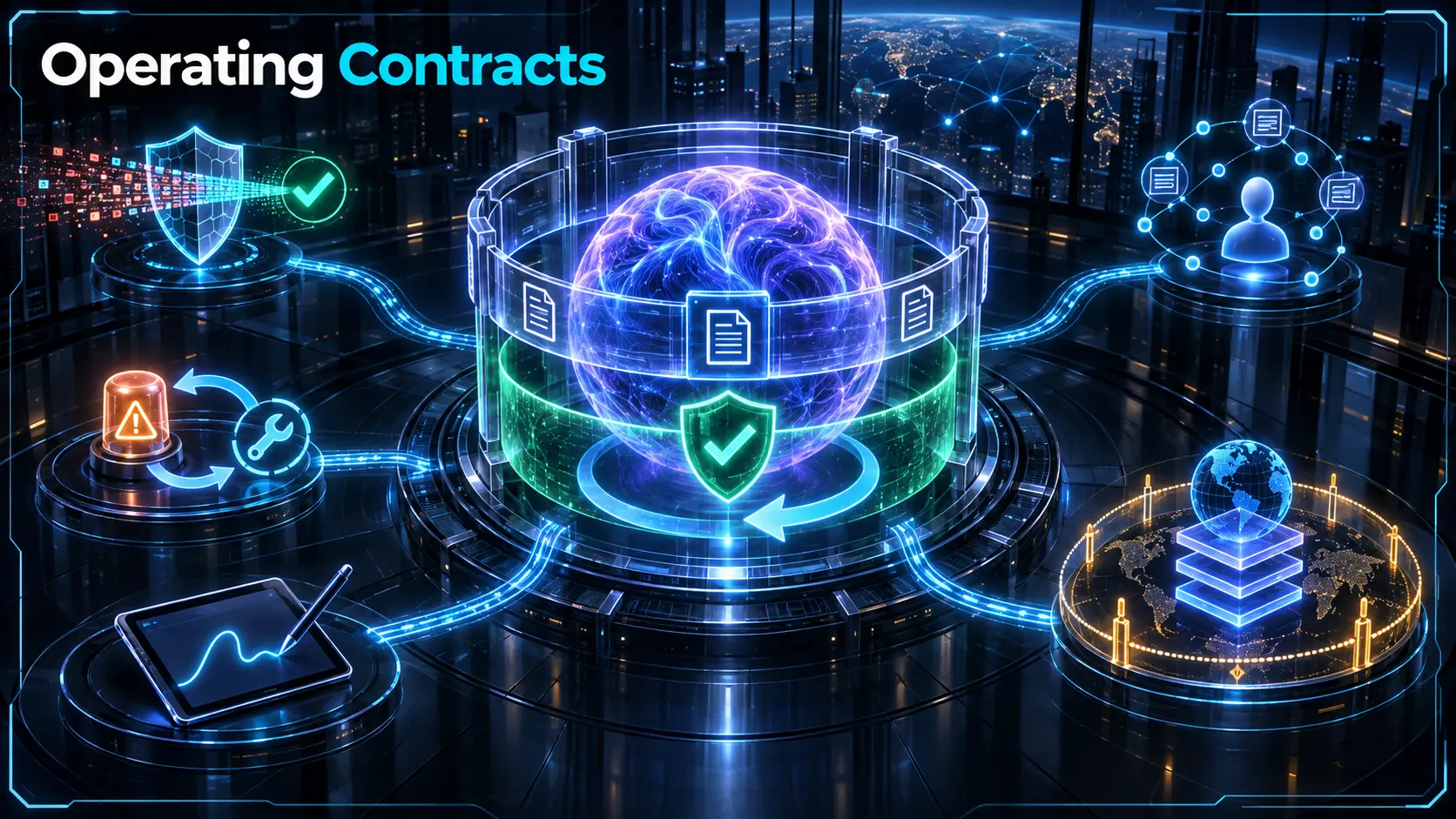
An abstract control room showing bounded AI agent operations and visible evidence trails
The week in view

The operating contract matters

Production value now depends as much on the operating contract as on model capability.

Altior — our view this week

AI agents are becoming operational systems, not just assistants. OpenAI’s Defense Factory, Anthropic’s CI responder and OpenClaw’s new release all describe agents working continuously inside security, software delivery and platform operations.

That changes the question. Persistent agents are useful when their authority is bounded, their evidence trails are intact, their recovery is explicit and their incident state is readable to the people accountable for the work.

The thread running through this issue is that production value now depends as much on the operating contract as on model capability.

OpenAI / ChatGPT / Codex

OpenAI / ChatGPT / Codex in view

OpenAI publishes its Defense Factory playbook

OpenAI says more than 250 people strengthened defences across hundreds of systems, using cyber models to find vulnerabilities, validate them and verify fixes. The important detail is the loop: discovery does not end at a finding. It carries through validation and proof that the remediation held. That is a useful description of where agents belong in security operations: inside a controlled path with an observable result, not as a detached answer engine.

Our takeThis is the right frame for persistent agents. Bounded authority, evidence at every stage and a verifiable finish are the operating contract.

Sketch lets users draw directly inside ChatGPT

OpenAI has introduced Sketch inside ChatGPT for ideas that are easier to draw than describe. Rather than translating a rough spatial or visual thought into a long prompt, a user can show the interface what they mean and continue the conversation from there. It is a small interaction change, but it moves intent capture closer to the work itself. For operators, the question is whether the sketch becomes durable context or remains a disposable prompt attachment.

Our takeThe value is not drawing for its own sake. It is reducing the loss of meaning between a person’s first thought and an agent’s next action.

Source

Astra reaches Codex and ChatGPT Work users

Astra is now fully rolled out to Plus, Pro, Business and Enterprise users in Codex and ChatGPT Work. The rollout matters because product access is part of an operating model: a capability cannot become a dependable workflow while it is limited to a small testing cohort. It also puts the same named capability across individual, team and enterprise contexts, where the controls and accountability expectations are different.

Our takeAvailability is the beginning, not the proof. We want to see how Astra behaves inside the permission, recovery and audit boundaries that real teams need.

Source
Anthropic / Claude

Anthropic / Claude in view

Claude Tag acts as Anthropic’s CI first responder

Anthropic describes Claude Tag as a CI first responder. The agent reads alerts, metrics and logs, writes a situation report, and keeps a lessons file while it detects, triages and resolves CI failures. That chain is more consequential than a chatbot that summarises a broken build. It gives an incident a readable state, makes the evidence trail explicit and leaves a record intended to improve the next response.

Our takeThis is what operational agent design looks like: observe, state the situation, act within bounds, and retain the lesson.

Source

Claude Marketplace expands to more agent products

CrowdStrike, Cursor, Factory, Gamma and Vercel are joining Claude Marketplace. Anthropic says enterprises can use spend commitments to buy more Claude-powered products and agents through that route. The practical shift is commercial and operational at once: agent products are being placed inside the procurement path rather than treated as isolated experiments on individual cards. That raises the need to know precisely what an agent can access, who owns the outcome and what happens when a supplier changes or disappears.

Our takeMarketplace access does not remove the need for a contract. Enterprise buyers still need clear authority, provenance and an exit path for every agent product.

Google / Gemini / DeepMind / Antigravity

Google / Gemini / DeepMind / Antigravity in view

Gemma 4 plans continuity for chunked MiniMax video generation

A third-party ComfyUI sampler uses Gemma 4 as a local production planner between MiniMax rendering passes. Its purpose is to reduce the manual prompt handoff required when a longer video is generated in chunks. The claim is not perfect continuity; it is a workflow layer that carries a plan between steps. That distinction matters. Multi-step generation needs a state that the next pass can read, inspect and correct.

Our takeWe like the direction: continuity should be treated as operational state, not a wish encoded in another prompt. The limitations need to stay visible.

Source
Meta / Llama

Meta / Llama in view

Meta launches Muse as a personal AI agent

Meta has entered the personal-agent category with Muse, a product designed to get to know a user over time. Meta has also published a deep dive on its safety design. A personal agent’s value comes from persistence, but persistence is exactly what makes authority and memory consequential. A system that learns a user’s preferences needs boundaries on what it may infer, retain and act on, plus a clear way to inspect or recover its state.

Our takePersonalisation is not a free pass for opaque behaviour. The durable product is the one that makes its memory and safety posture legible to the person it serves.

Source
OpenRouter

OpenRouter in view

GPT Image 2.5 reaches OpenRouter in two models

OpenRouter has added two GPT Image 2.5 options: Flare for faster, high-volume generation and Sunburst for tighter edit control and production precision. The split makes a useful operational point. Image generation is not one job, and a route that optimises throughput can be the wrong choice when an approved asset needs controlled revisions. Teams need to know which model path created which output before an asset enters a wider workflow.

Our takeChoice is useful when it stays explicit. Keep the model route, edit history and approval state with the asset, not in someone’s recollection.

NousResearch / Hermes

NousResearch / Hermes in view

Hermes Agent adds the Perplexity Search API

Hermes Agent can now use the Perplexity Search API as a retrieval tool. Retrieval gives an agent a route out of its own parametric memory, but it also introduces a new dependency into the chain of evidence. The useful system is not one that simply finds an answer; it can show what it retrieved, distinguish source from inference and recover cleanly when retrieval fails or a source changes.

Our takeSearch tools make agents more capable, but they also make provenance non-negotiable. Evidence needs to travel with the action.

Source
Other

Other in view

Mistral raises €3 billion around sovereign open-weight AI

Mistral’s €3 billion raise frames jurisdictional independence and open weights as a frontier strategy for European AI procurement. The proposition is not just a model choice. It is an argument about who can inspect, host, adapt and govern a capability when the work is sensitive or the operating environment has particular legal and geographic constraints. Procurement teams will read this through the lens of control as much as performance.

Our takeSovereignty is an operating requirement when it is real. The test is whether the deployment, evidence and recovery model match the claim.

Source

The Navier–Stokes AI priority dispute goes mainstream

Two high-traffic discussions and a report alleging that OpenAI fought dirty over a career-making mathematics result have pushed provenance and priority into the centre of the AI cycle. The dispute is a reminder that a result is not only an output. In consequential work, people need a human-readable account of who contributed what, when a claim was made and how the evidence can be examined. That is as true for agent-led research as it is for any other scientific process.

Our takeThe lesson is simple: provenance cannot be reconstructed as an afterthought when priority is disputed. Build the trail while the work happens.

Source

Large language models develop new social biases through exploration

Reported research says adaptive exploration can produce novel social biases rather than merely reproduce existing ones. If that finding holds, it complicates the comforting idea that a model’s social behaviour is fixed at training time. Systems that explore, adapt or operate persistently need ongoing observation of their behaviour, a way to capture the evidence and an explicit recovery path when a pattern crosses a boundary.

Our takeThis is why continuous agents need controls that continue too. A one-time safety review is not an operating contract.

Kimi K3 runs from four SSDs on a MacBook Pro

Kimi K3, described as a 2.8-trillion-parameter model, reportedly streamed at one token per second from four SSDs on a MacBook Pro. The experiment points to extreme-offload local inference becoming a hobbyist reality. It also separates the headline from the usable workflow: a system can technically run while still carrying constraints around speed, storage, reliability and recovery. Local capability changes the design space, not the need for clear service expectations.

Our takeWe are watching local inference closely, but the operational question stays the same: what does it reliably do, under which constraints, and how does it recover?

Qwen3.8-27B quantization testing finds four-bit holds while one-bit collapses

Benchmarking of Qwen3.8-27B quantization reports that four-bit holds while one-bit collapses. That is a practical signal for teams weighing local-model quality against hardware cost. Quantisation is not a single dial that can be turned down indefinitely; the acceptable point depends on the task, evaluation method and failure tolerance. Without those elements, a compression result is not yet an operating decision.

Our takeThis is the right kind of local-model question: measure quality against the work, retain the test evidence, and choose the smallest viable system rather than the smallest number.

An output-discipline skill becomes a 30,840-star signal

The i-have-adhd repository reached the Hacker News front page with an answer-first contract for coding agents. Its 30,840-star signal exposes a discovery gap in new-repository-only tracking: useful agent practices can become widespread quickly, while a narrow monitoring rule can miss the adoption entirely. The skill’s premise also lands with this issue. Agent quality is often shaped by the operating instructions around output, handoff and completion, not only by the model underneath.

Our takeThe signal is strong because the contract is concrete. Good agent operations make the next action, evidence and completion state obvious.

Source

A tracked 1,181-star AI repository disappears overnight

The short-video-generator-AI repository and its owner account both returned 404. The disappearance demonstrates why marketplace dependencies need a takedown response and an exit plan. A capability that lives only behind someone else’s repository or account is not a stable operating component, however compelling its first demo may be. Teams need to know their substitute path, retained assets and response owner before a dependency vanishes.

Our takePersistent workflows need recovery designed in. An agent stack is only as dependable as its plan for a component that disappears overnight.

ALTIOR AI ADVANTAGE
Keep reading

Build agents that leave a trail.

For more practical AI systems thinking, read the Altior blog and explore the prompt library.

The Altior blogThe prompt library