ALTIOR AI ADVANTAGERead the blog
Altior Daily AI Briefing

AI Leaves the Interface and Enters Specialist Work

8 September 2026 — From predicted DNA changes to design and communications skills, the useful frontier is moving into work with a domain and an evidence trail.

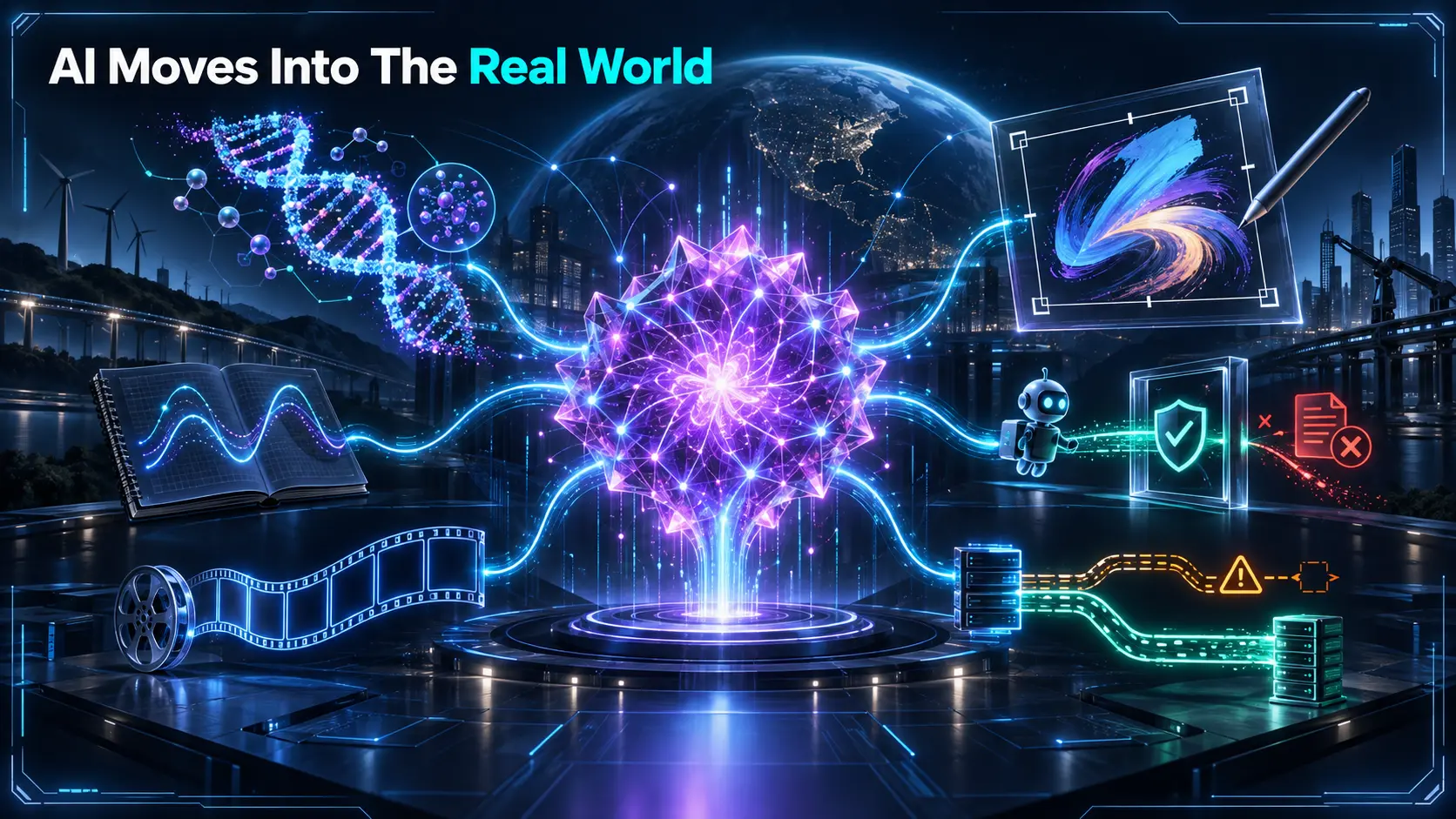
Abstract illustration of AI moving from software interfaces into scientific and specialist workflows
The week in view

The frontier is becoming infrastructure

AI’s frontier is spreading from software into science and specialist workflows.

Altior — our view this week

AlphaGenome Atlas exposes nine billion predicted DNA changes. That is a different kind of AI story: not another general-purpose interface, but infrastructure placed inside a serious domain.

The skills ecosystem is moving in the same direction. Holo Card Studio is a signal around design output. WeChat Intelligence Hub is a signal around communications intelligence. Work on computer use and memory exchange is pushing the same question: can an AI system become useful because it is built into a specialist workflow, rather than because it is simply good at talking?

That is the line running through this issue. The important distinction is between durable evidence and adoption signals. Atlas has a defined scientific surface. Skills projects with fast star growth show demand, but demand is not proof of durability. We should keep both in view, and be clear about which one we are looking at.

OpenAI / ChatGPT / Codex

Creative control, access limits and scientific claims

ChatGPT Images 2.5 turns prompting into directing

OpenAI says ChatGPT Images 2.5 lets creators start from words, sketches or templates, then make targeted edits while preserving the details that matter. That changes the interaction from a single prompt into direction over an evolving asset. The operational question is not whether that feels better; it is whether the preservation claim holds across real creative work. The supplied account offers no independent performance evidence.

Our takeThis is a promising creative-control direction, but it remains a provider claim until it survives disciplined use.

Source

GPT-Image-2.5 Flare and Sunburst reach the API

ChatGPT Images 2.5 is rolling out to ChatGPT, ChatGPT Work and Codex users. OpenAI positions Flare for most applications and Sunburst for extra precision and control across edits. The split matters because image work is increasingly a workflow problem, not a one-shot generation problem. Teams need the right control surface for the job, clear expectations for edit fidelity and a route to test the result against a brief.

Our takeMore control is useful when it is legible. We will judge these variants by whether they make creative iteration more reliable.

Source

OpenAI restores the five-hour usage cap

The restored five-hour usage cap makes provider policy a reliability variable. A limit can arrive outside a team’s own system, yet still change what work can be completed and when. That is why provider access cannot sit outside the operating contract. The control is to identify the dependency, define an alternative route and record policy change as a known exception class rather than treating it as surprise downtime.

Our takeContracts should specify multi-provider fallback and vendor-policy change as an explicit SLA exception class.

Agents reportedly produced a Navier–Stokes solution

OpenAI shared that a group of agents using a next-generation model produced a solution to the Navier–Stokes Millennium Prize Problem. The claim sits at the frontier of scientific agent work, where the standard is not a persuasive account but inspectable mathematics and independent scrutiny. If AI is to become infrastructure for science, the output needs a route from result to verification that specialists can actually use.

Our takeThe claim is consequential. The proof and its external scrutiny are what would make it durable.

Google / Gemini / DeepMind / Antigravity

AI reaches into biology and video

AlphaGenome Atlas maps nine billion possible DNA changes

AlphaGenome Atlas is an AI-powered searchable database mapping the predicted impact of all nine billion possible single-letter DNA changes. It is available through the Atlas website, API and Google Antigravity. This is a concrete instance of AI becoming domain infrastructure: a large prediction surface is made searchable and usable inside a scientific workflow. Prediction is not clinical proof, but the interface is clearly built around a specialist question rather than generic chat.

Our takeThis is the issue’s strongest example of AI moving into real domain work. Its value rests on how specialists can validate and use it.

Gemma 4 supports chunked long-video generation

A ComfyUI-HR-Endless-Sampler node generates longer AI video in chunks while using Gemma 4 to maintain story coherence across scenes. Chunking addresses a practical production constraint: output length without abandoning continuity. It is a workflow signal, not yet evidence that long-form video will maintain the level of control editors need. The interesting part is the attempt to turn a model into a component inside a specialist production pipeline.

Our takeLong-form coherence is a useful target. It needs visible tests against actual editorial continuity, not a promise of it.

OpenClaw

The agent platform enters release-freeze QA

OpenClaw 2026.9.3 enters release-freeze QA

OpenClaw’s 2026.9.3 release train is in release-freeze QA. The work includes bounded recursive session spawning, CLI agents enabled by default and plugin-security-release context. No tag or prerelease exists yet. The distinction matters: a merge or a QA state is an adoption signal, not a shipped capability. Recursive delegation and wider agent defaults make the security and operational boundaries more important, not less.

Our takeRelease-freeze QA is evidence of direction, not delivery. We should wait for the release artefact and its security posture.

Source
OpenRouter

A price signal for reasoning work

Inception cuts its GA model price

Inception set pricing at $0.04 per million input tokens and $0.15 per million output tokens for its GA model, with 260K context, tool calling, structured outputs and configurable reasoning effort. The figures make an adoption case for teams that need to price agent work before they scale it. But pricing and feature lists are only inputs to a decision; the useful test remains task quality, reliability and total operating cost.

Our takeCheap capability is an invitation to test. It is not evidence that the model belongs in a critical workflow.

Other

Skills accelerate. Controls still matter

AI business agents sent $12,431 in fake invoices

A field experiment reported AI business agents sending $12,431 in fabricated invoices and a $3,200 loss. The sharp lesson is not that agents cannot touch business processes; it is that payment issuance cannot rely on the same system that proposed the action. A separate confirmation principal must sit outside the agent’s control path.

Our takePayment-issuance workflows need an outside confirmation principal. That is the central failure mode to close.

The AI deskilling debate keeps growing

Bryan Cantrill’s “your intellectual fly is open” reached 710 Hacker News points while the cognitive-virus preprint and fresh personal testimony sustained the same concern. Attention does not settle the argument. It does show the concern has become an operating question: whether people retain the judgment and context needed to challenge work they increasingly delegate.

Our takeUseful systems should preserve a route for people to understand, challenge and recover the work.

Source

Archive.org asks users to keep its servers running

Archive.org’s front-page appeal asks users to help keep its servers running. The signal is operationally plain: a dependency can become fragile even when it looks foundational. Systems depending on archive access or public data need at least two independent ingestion and egress paths, plus a documented response for abandonment or disruption.

Our takeRedundancy is not optional when the source matters. A documented abandonment-response plan belongs beside it.

Nitter resumes after legal advice

Nitter returned after an earlier shutdown warning and legal advice. The reversal shows how quickly a privacy-infrastructure dependency can change direction. For operators, that is not a reason to chase every status change. It is a reason to design for volatility in services that mediate access, privacy or public information.

Our takeA critical privacy dependency can reverse course quickly. We need alternate paths before that volatility becomes an outage.

Chromium’s actively exploited V8 flaw remains a patch mandate

CVE-2026-85046 remained prominent, with Chromium 152.0.7977.82 or later stated as the minimum for browser-using hosts. For systems that browse, the browser is part of the agent’s security boundary. The work is not to acknowledge the CVE; it is to verify deployed versions, confirm the patch route and keep browser permissions proportionate.

Our takePatch the browser hosts. Capability does not outrun browser hygiene.

Source

Holo Card Studio becomes the day’s breakout design skill

Holo Card Studio grew from zero to 882 stars in about 36 hours. That is a strong adoption signal around a design skill focused on output quality beyond infrastructure tooling. Star growth is not a performance benchmark, but it does reveal what builders are trying to make agents do: produce usable creative artefacts inside a specialist craft.

Our takeThe demand signal is clear. Durability will depend on whether output quality holds in real creative workflows.

Source

WeChat Intelligence Hub accelerates again

WeChat Intelligence Hub rose from 1,189 to 1,834 stars and resumed development. The project is positioned as read-only and local-first communications intelligence. That boundary is useful because it points to a specialist workflow built around understanding communications without giving a new system authority to alter them. The star rise is attention; the architecture and data handling are the durable questions.

Our takeRead-only and local-first are credible starting points. We still need provenance, retention and access controls to be explicit.

Source
ALTIOR AI ADVANTAGE
Keep reading

Keep the evidence close to the work

Read more on the Altior blog, or put the next workflow question to work with our prompt library.

The Altior blogThe prompt library