Anthropic opened a window onto real Claude use—not the chats
Three outside teams studied patterns across roughly 250,000 Claude conversations, while the conversations themselves stayed inside Anthropic’s privacy-preserving process.

Anthropic says it has given external researchers a way to study AI’s impacts using real, privacy-preserved Claude usage data. Three groups examined aggregate patterns from roughly 250,000 Claude.ai or Claude Code conversations, without receiving the conversations themselves.
That opens a useful, limited window. Outside teams could choose the questions; Anthropic still ran collection, privacy review and the release process. The pilot is a test of controlled scrutiny, not an open archive.
Outside questions change the evidence
Real-world use can be studied beyond a lab’s own agenda, provided the limits around that access remain visible.

Most evidence about how people use AI sits with the companies running the systems. Public datasets can be useful, but they do not necessarily show ordinary use at scale. A route to real usage patterns lets outside teams pursue questions the lab did not choose.
The qualification matters as much as the opening. Anthropic says researchers were free to publish findings it might dislike, but the company retained a role in the process that produced and reviewed the aggregate outputs.
What the pilot actually covered
The published account names three groups, a defined period and aggregate analysis—not a general-access research programme.
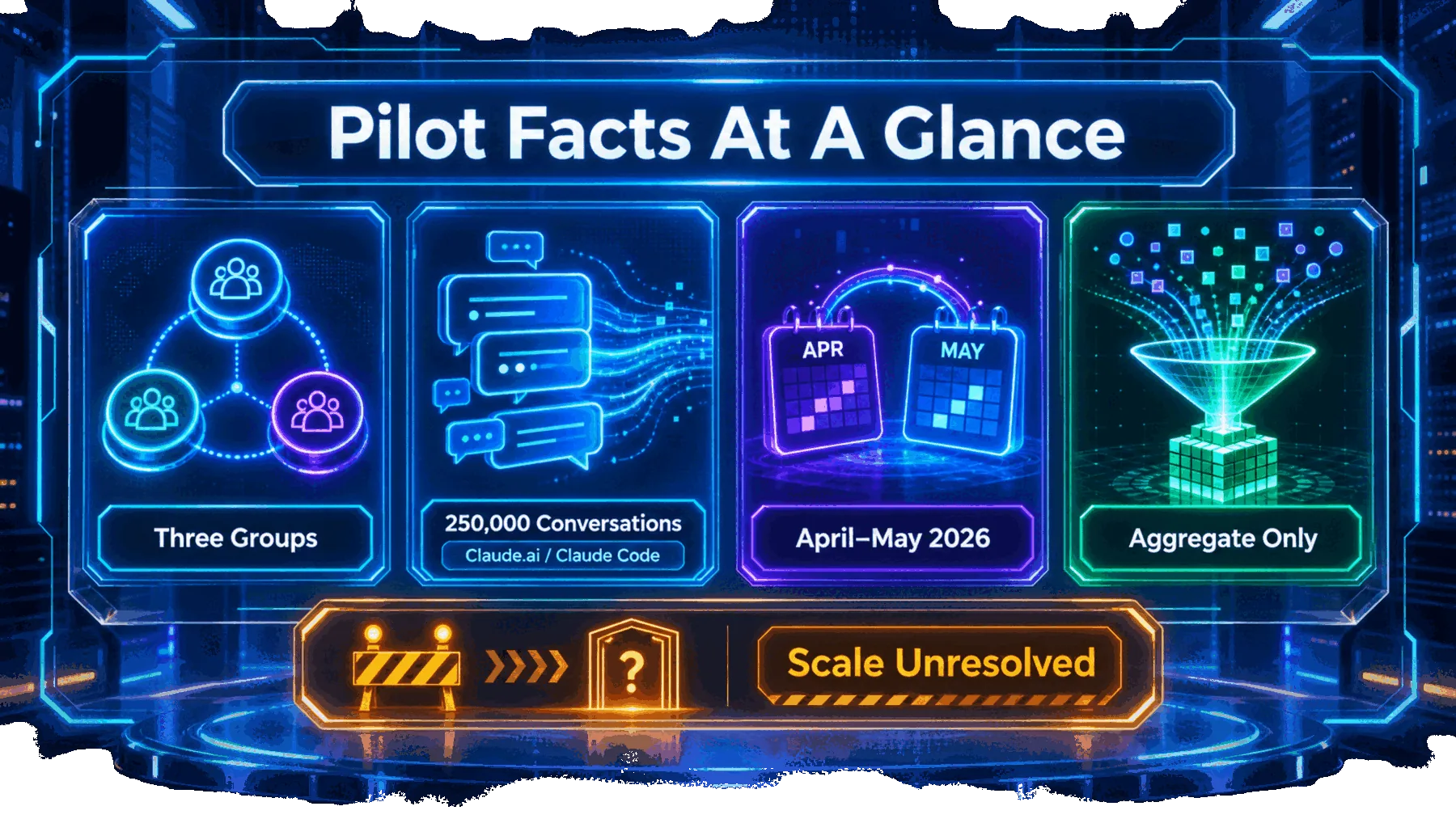
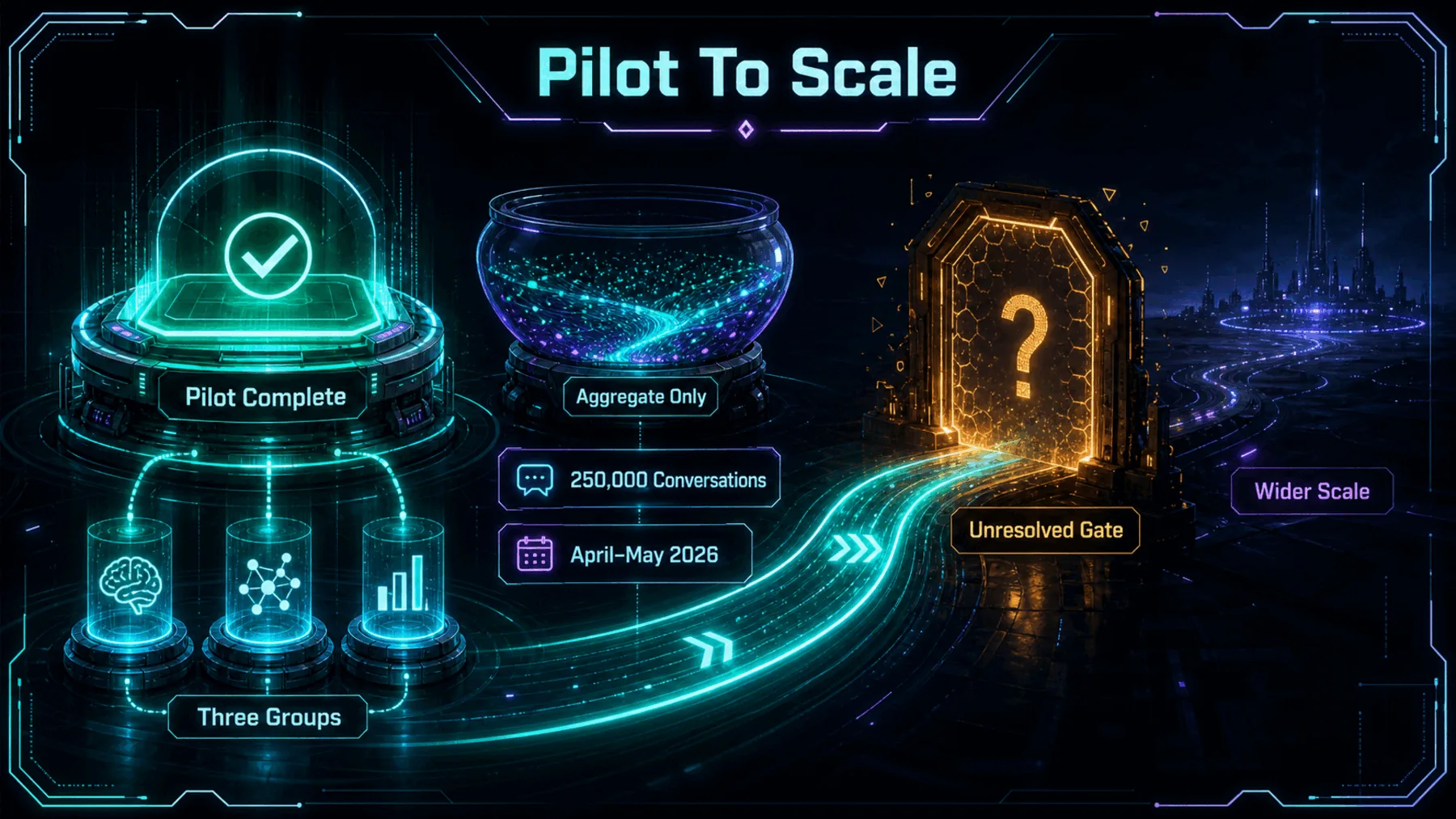
The figures establish scale, but not representativeness. Anthropic says the analysis covered roughly 250,000 conversations during April and May 2026; it does not establish a picture of every Claude interaction, every AI system or every kind of work.
Anthropic also reports that less than 5% of categories and conversations were altered or removed in each study, with the affected clusters and reasons disclosed to researchers. That is a description of the review process, not a privacy, error or censorship rate.
Anthropic says it opened the tools
Its public announcement frames the move as a first route for outside researchers to study real, privacy-preserved Claude use.
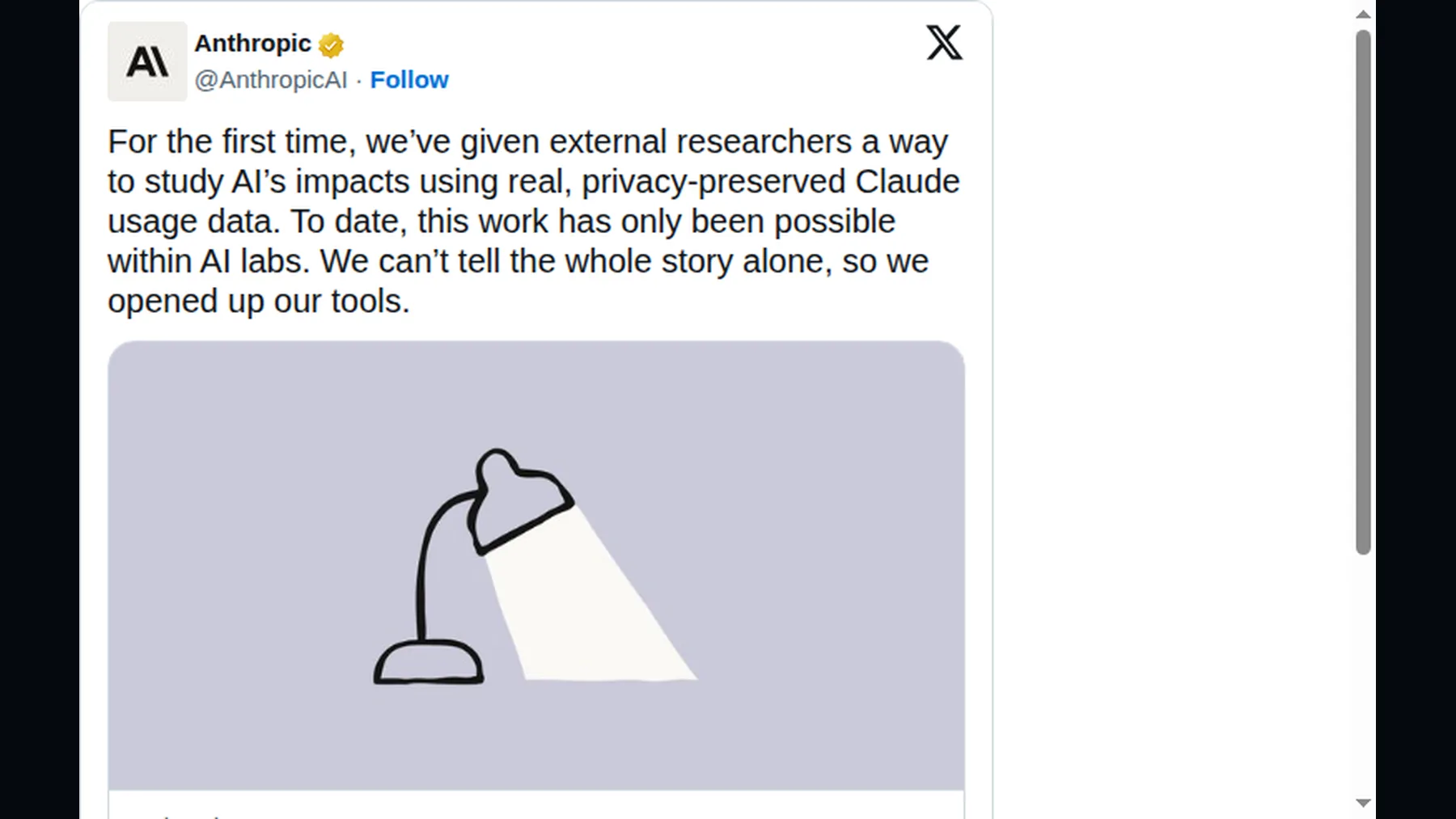
Anthropic’s central claim is deliberately ambitious: it says this is the first time it has given external researchers a way to study AI’s impacts using real, privacy-preserved Claude usage data. The company also says this work had previously been possible only within AI labs.
The more revealing line is simpler: “We can’t tell the whole story alone, so we opened up our tools.” That is the case for outside questions—but the tools were opened through a managed process, not handed over as raw material.
“We can’t tell the whole story alone, so we opened up our tools.”
Anthropic on X, 26 August 2026
The proof—and its boundary
Anthropic’s account supports a meaningful access claim, while making clear that raw conversations did not leave its control.
Aggregate outputs are patterns and grouped results drawn from many conversations, not a bundle of transcripts. Anthropic says the researchers never accessed raw conversations and used Anthropic Insights to conduct the privacy-preserving analysis.
The same article says Anthropic retained review rights around privacy, policy-circumvention risk, confidential information and research accuracy. Those constraints do not erase the researchers’ stated freedom to publish; they define the terms under which the evidence was released.
The value of this pilot is not unrestricted access. It is a visible attempt to let outside questions reach real-use evidence without moving private conversations across the boundary.
Synthesis from Anthropic’s published account
A controlled analysis window
Researchers brought the questions; Anthropic’s process produced reviewable aggregate outputs for analysis and publication.
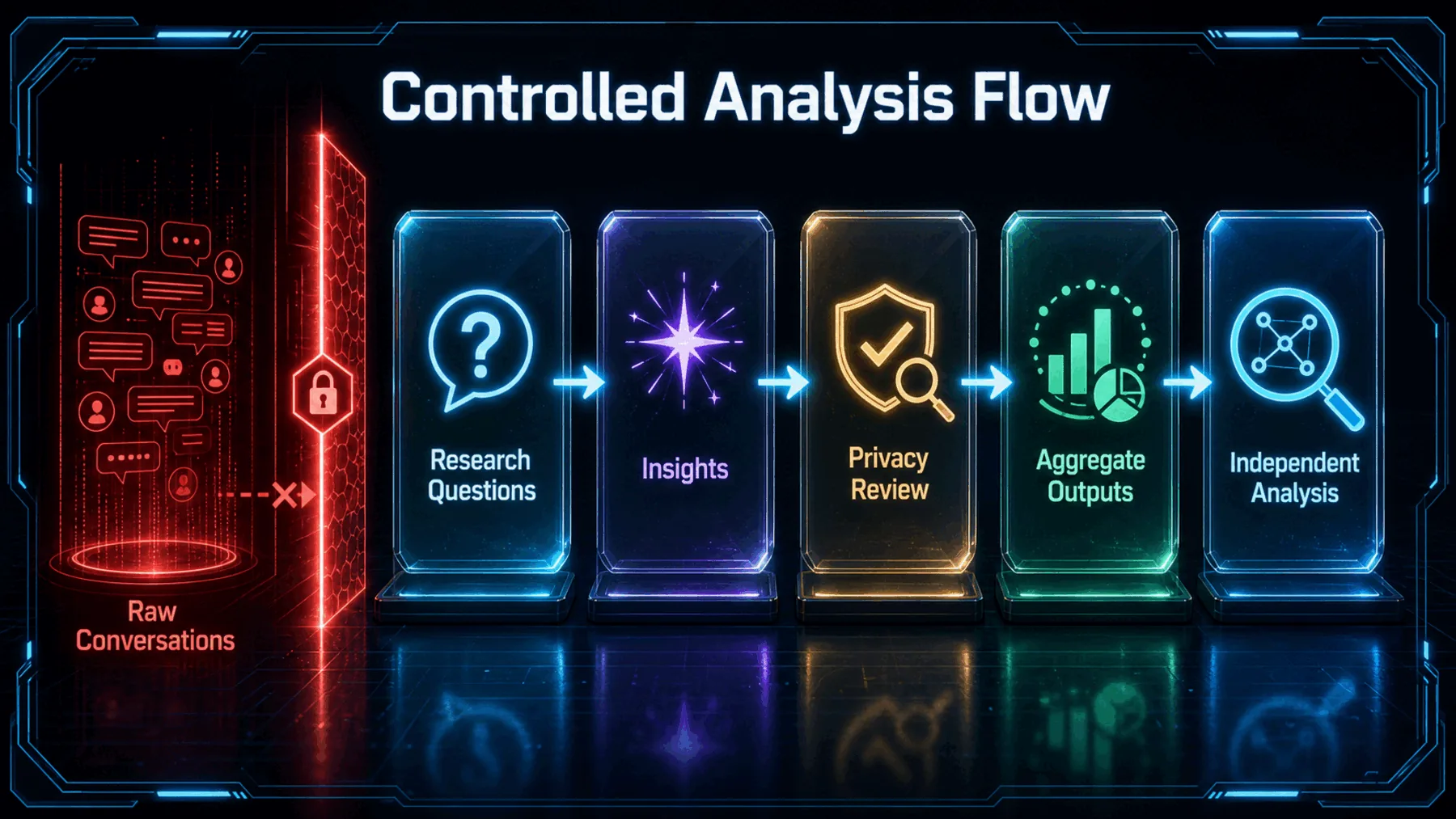
The published sequence is straightforward. A research team defines a question, Anthropic’s system runs privacy-preserving analysis, legal and privacy review is applied, and aggregate outputs are returned for the team’s analysis.
Anthropic says it otherwise had no say in the findings and that the groups could publish inconvenient results. The distinction is important: the question and interpretation could sit outside the company, while the handling of underlying conversations did not.
What researchers could—and could not—do
The pilot offered researcher-chosen questions and aggregate evidence, with a slower, managed route whose wider availability remains undecided.

For a team studying how AI changes work or behaviour, real-use patterns can answer questions that laboratory tasks cannot. Anthropic says the participating groups selected their own questions and could publish conclusions that were inconvenient for the company.
Yet this was not a self-serve route. Anthropic says the pilot was slow and resource-intensive, and it is collecting expressions of interest while deciding what kinds of studies it can support and how many can run at once.
Own questions
The three groups developed their own research questions.
Aggregate only
Researchers received grouped outputs, never raw conversations.
Scale undecided
Anthropic is still assessing supported study types and concurrent capacity.
The real experiment is controlled scrutiny
The test is whether outside teams can pursue meaningful questions of real AI use while privacy and operational limits remain explicit.
Outside scrutiny becomes more credible when researchers can choose the questions—and more trustworthy when the controls around private evidence are named rather than hidden.
Synthesis from Anthropic’s published account
Anthropic has not opened Claude conversations to the public, nor has it completed the case for a scalable research programme. It has described a more modest experiment: letting outside teams study real-use patterns through a process it still operates and reviews.
That modesty is the point. The pilot’s early value lies in making both halves legible: research questions can come from outside the lab, while the protection and handling of private conversations remain bounded by stated controls.
Separate the questions from the controls
Act as a research-methods editor. Based only on Anthropic’s published description of its Claude usage-data pilot, write a two-column assessment: first, what outside teams controlled; second, what Anthropic retained control over. Include the stated scale of roughly 250,000 Claude.ai or Claude Code conversations from April–May 2026, explain that researchers received aggregate outputs rather than raw conversations, and end with three unanswered questions about wider scale. Do not infer that privacy protections, research findings, or institutional independence were independently verified.Ready to copy
Watch what opens next
Keep the pilot’s access claim separate from the questions Anthropic has yet to answer about supported studies, concurrent capacity and broader availability.
Try the promptSignals that could change the picture
- Supported studies
- Concurrent capacity
- Broader access